Overview
The Peruvian Hairless Dog has been kept in the Andes for well over a thousand years and is honoured as part of Peru's cultural heritage. Hairlessness is its defining feature, although coated puppies appear in the same litters.
It is a graceful, harmonious dog that comes in small, medium and large sizes, so it can fit a wide range of homes.
History
Hairless dogs appear on Moche, Chimú and Vicus ceramics, with depictions dating from around 750 AD. They were kept in the Inca Empire, where Spanish chroniclers counted them among several distinct dog types, and in earlier coastal cultures.
The breed was later adopted by the FCI with an official standard. In the United States, enthusiasts developed a related type, the Peruvian Inca Orchid, from dogs brought from Peru in the early twentieth century.
Appearance
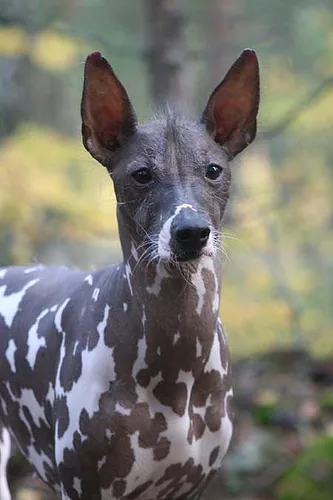
This is a slim, elegant dog giving an impression of strength and harmony without coarseness. The body is roughly square, and the ears are erect and candle-flame shaped. Skin may be chocolate-brown, elephant-grey, copper or mottled, with eye colour linked to skin colour.
Small dogs stand 25 to 40 cm, medium 40 to 50 cm and large 50 to 65 cm, with weights from about 4 kg up to 25 kg. Hair may remain on the head, feet and tail tip, and many dogs lack some teeth.
Temperament
Peruvian Hairless Dogs are alert, loyal and affectionate with their families, and they can be reserved with strangers. They make attentive watchdogs and usually bond strongly with one household.
They are intelligent and active but not extreme, and enjoy close company and play.
Care and exercise
Hairless skin needs attention: sun protection, moisturising and occasional gentle bathing, plus warmth in cold weather. Coated dogs need only light brushing.
Daily walks and play are enough for most, and they should live indoors as part of the family. Dental care is worth extra attention because of missing teeth.
Health
The hairless trait is linked to missing teeth, mainly molars and premolars. Hairless skin is prone to sunburn, dryness and acne. The hairlessness gene is lethal in double dose, so hairless puppies are always paired with coated littermates in the average ratio of about two to one.





