Overview
The Xoloitzcuintle, often called the Xolo, is one of the world's best-known hairless dogs. It comes in toy, miniature and standard sizes, and in both hairless and coated varieties that can be born in the same litter.
Its name comes from the Aztec god Xolotl and the Nahuatl word for dog. Today it is treasured in Mexico as a cultural symbol and kept elsewhere as a calm, watchful and affectionate family companion.
History
Ceramic figures of hairless dogs have been found in ancient burial sites in western Mexico, and dogs resembling Xolos were said to guide souls to the underworld. They were honoured in Maya and Toltec cultures too.
The breed received little official attention until the 1950s, when an expedition found a handful of sound dogs in remote parts of Mexico to rebuild the population. The first standard was written and the breed was recognised in 1956. The American Kennel Club recorded a Xolo as early as 1887 and fully accepted the breed in 2011.
Appearance
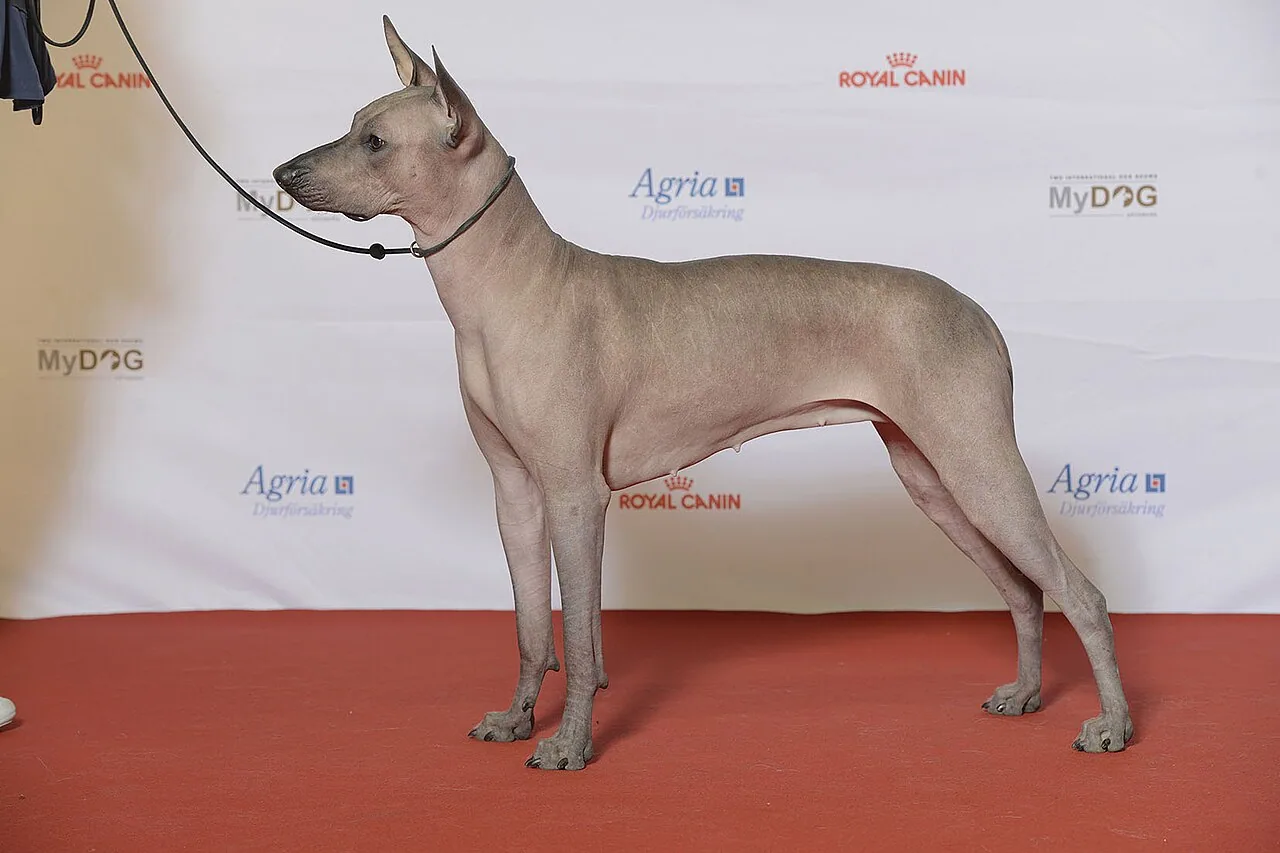
The Xolo is sleek, rectangular and elegant, with a long neck, almond-shaped eyes and large bat-like ears. It gives an impression of strength and agility without exaggeration. The hairless variety has smooth bare skin, sometimes with a few hairs on the head, feet and tail tip, and often has incomplete teeth.
The coated variety wears a short, flat, dense coat and has a full set of teeth. Both types come in three sizes, from about 25 cm to 60 cm at the shoulder.
Temperament
Xolos are calm, attentive and deeply attached to their people. They are often reserved with strangers and make alert watchdogs, though they are not usually noisy. They are intelligent, playful with family and tend to bond closely with one household.
Puppies can be lively and need patient, kind training and early socialisation. Adults are usually quieter and happy to curl up beside you.
Care and exercise
Originating in warm regions, the Xolo is best kept indoors and needs warmth, a coat in cold weather and sun protection for bare skin. Regular gentle bathing, light moisturising and basic skin care keep it comfortable; over-bathing can strip natural oils and clog pores.
Daily walks and play meet its exercise needs. Coated dogs need only occasional brushing.
Health
Hairless Xolos often have missing teeth, so dental care matters. Their bare skin can be prone to acne, dryness and sunburn if neglected. The hairless gene is dominant and carries a risk if inherited twice, so responsible breeding is important. Overall the breed is considered robust and long-lived.