Overview
The Norrbottenspets is a small to medium spitz from northern Sweden, closely related to the Finnish Spitz and the Karelo-Finnish Laika. It was kept as a hunting and farm dog in the arctic north.
Bright, tireless and curious, it is a lively companion for active owners, and it is still most at home working outdoors.
History
The breed is named after the province of Norrbotten. Its origins are unclear, but arctic and German Spitz blood are probably in its ancestry.
It nearly vanished in the 20th century, and in 1948 the Swedish Kennel Club declared it extinct. Enough dogs were found in the 1960s for it to be re-established, and today it is fairly popular in Sweden, though rare elsewhere.
Appearance
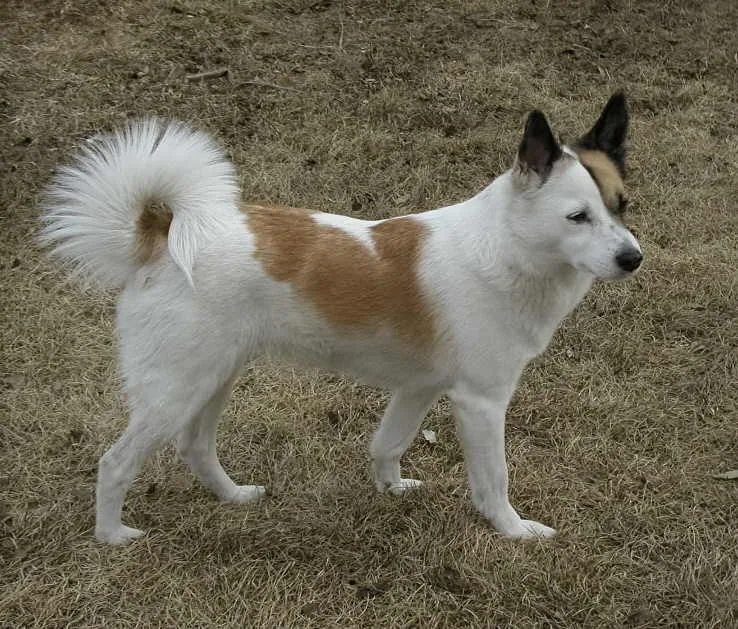
A compact, sturdy spitz, as long as it is tall, with a wedge-shaped head, erect ears, a deep chest and a high tail curled over the back. Males are 43 to 47 cm, females 40 to 44 cm, and weight is about 11 to 15 kg.
The thick double coat is short and hard, and the standard calls for white with yellow or red patches.
Temperament
Highly intelligent, energetic and curious, with a bold hunter's spirit. It is generally even-tempered but has little patience for being pestered by children.
Without enough activity it can become bored and destructive.
Care and exercise
It needs considerable daily exercise and real tasks, such as tracking, hunting, search work or dog sports. A secure garden helps, as its hunting drive is strong.
Grooming is easy, with a weekly brush and extra attention during seasonal shedding.
Health
A large Swedish insurance study from the mid 1990s found it had the lowest illness rate of all dogs studied, purebred and mixed.





