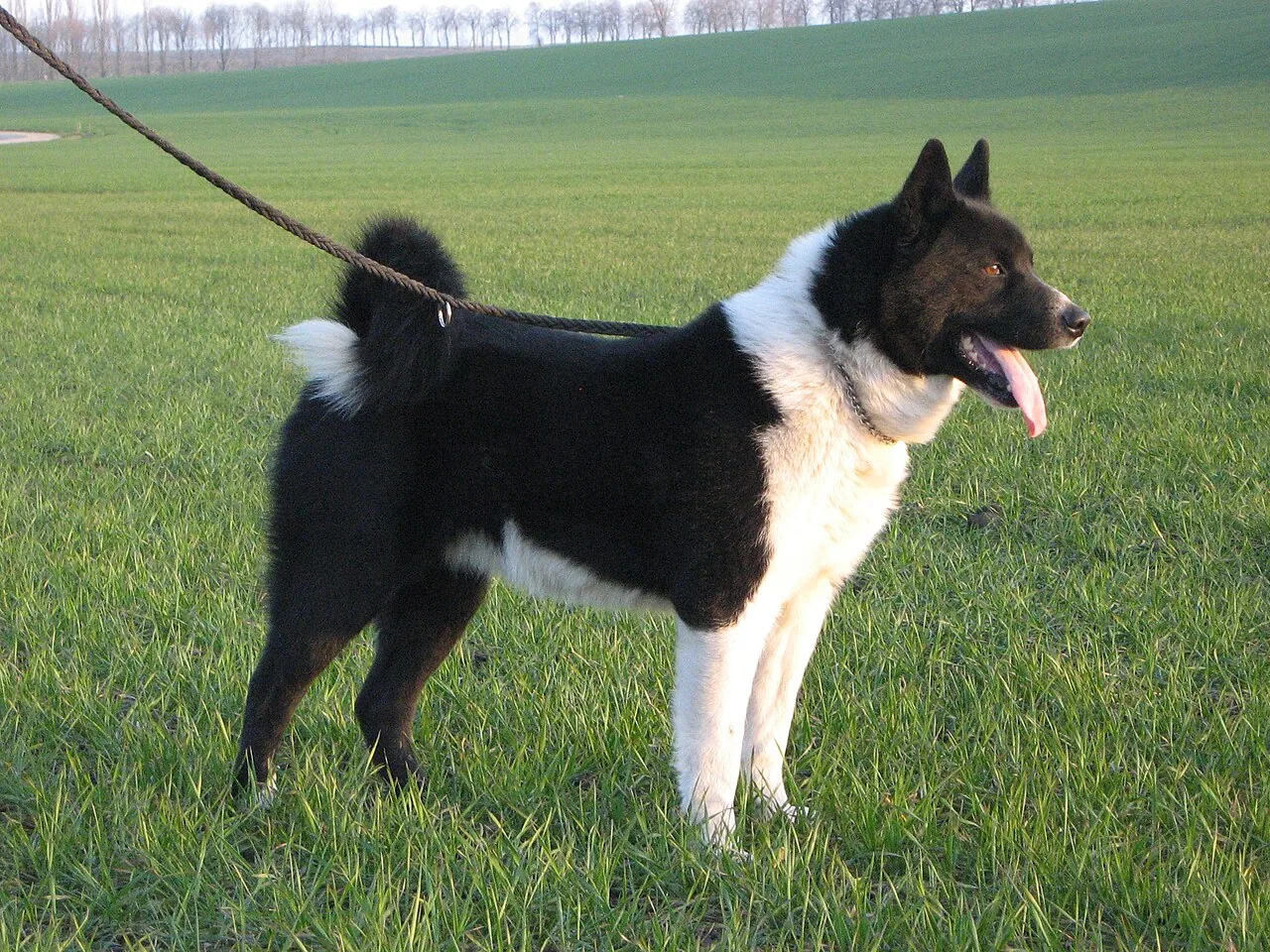
Overview
The Karelian Bear Dog is a sturdy, quick Finnish spitz bred to find and hold large game. It is regarded as a national treasure at home and is among the country's most common breeds.
It is intense, independent and very much a working dog, happiest outdoors with a job.
History
The breed descends from Komi-type dogs found in the Karelian region around Lake Ladoga. Organised breeding began in 1936 to produce a hardy dog that would bark at big game, the first standard appeared in 1945 and registrations began in 1946.
It hunted small fur animals as well as moose, lynx, wolf and bear. Today its skills are also used in wildlife management, where trained dogs help keep bears away from people in North America and Japan.
Appearance
A compact, strong spitz with a wedge-shaped head, erect ears and a tail curled over the back. Males stand 54 to 60 cm and weigh 25 to 28 kg; females are 49 to 55 cm and 17 to 20 kg.
The standard coat is black with white markings, with straight, stiff guard hairs over a soft, dense undercoat. Early dogs also came in grey, red and black-and-tan.
Temperament
Fearless and tenacious on the hunt, the Karelian is affectionate with its family and usually reserved, never aggressive, with people. It is territorial and alert, and often dominant or aggressive toward other animals, especially unfamiliar male dogs.
It is a social dog that can suffer from separation anxiety.
Care and exercise
This breed needs a great deal of exercise and mental stimulation, plus space to run in a securely fenced area. It is rarely suited to quiet urban life or first-time owners.
Early, thorough socialisation with animals and everyday sounds is essential. The double coat needs only regular brushing, with heavier care during seasonal shedding.
Health
An inherited chondrodysplasia, also known from the Norwegian Elkhound, has been found, caused by a recessive ITGA10 mutation. Pituitary dwarfism linked to the LHX3 gene, inherited from German Shepherd ancestry, also occurs. Breeders can test for both.





