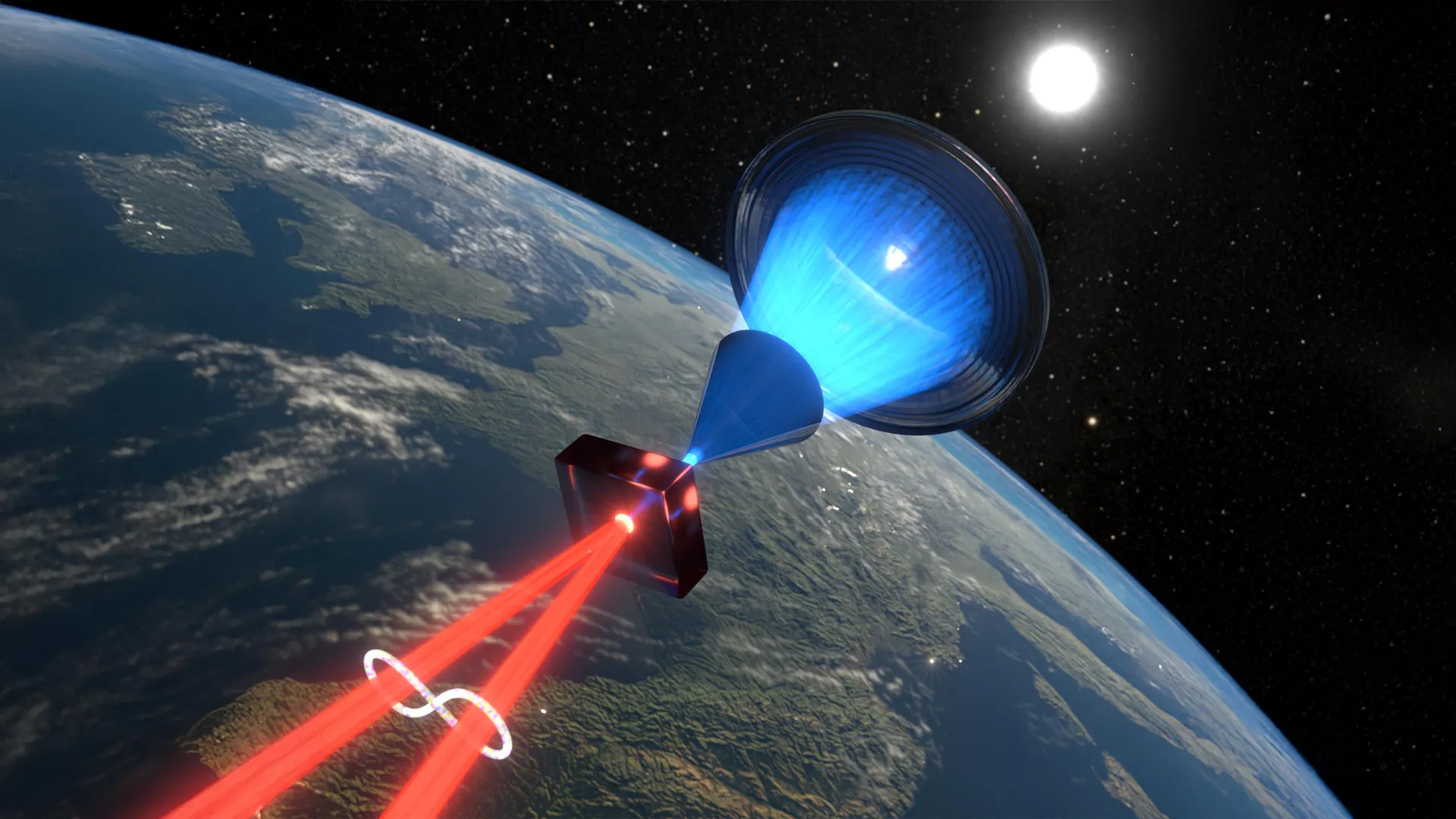
Researchers from the University of Ottawa and Germany's Max Planck Institute for the Science of Light have generated quantum-entangled photons using ordinary sunlight instead of a laser, a feat long thought impossible because sunlight lacks the coherence lasers provide.
The team, led by graduate student Cheng Li under physicist Robert Boyd, concentrated sunlight through a household-window-sized Fresnel lens into an optical fiber roughly the width of a human hair, then fed it into a millimeter-scale nonlinear crystal to trigger spontaneous parametric down-conversion, splitting photons into entangled pairs. Quantum state tomography confirmed a fidelity of about 94%, nearly matching laser-based setups.
The result, published in the journal Optica, points toward quantum technologies that do not depend on power-hungry lasers, including satellites that could generate secure encryption keys from sunlight already abundant in orbit.