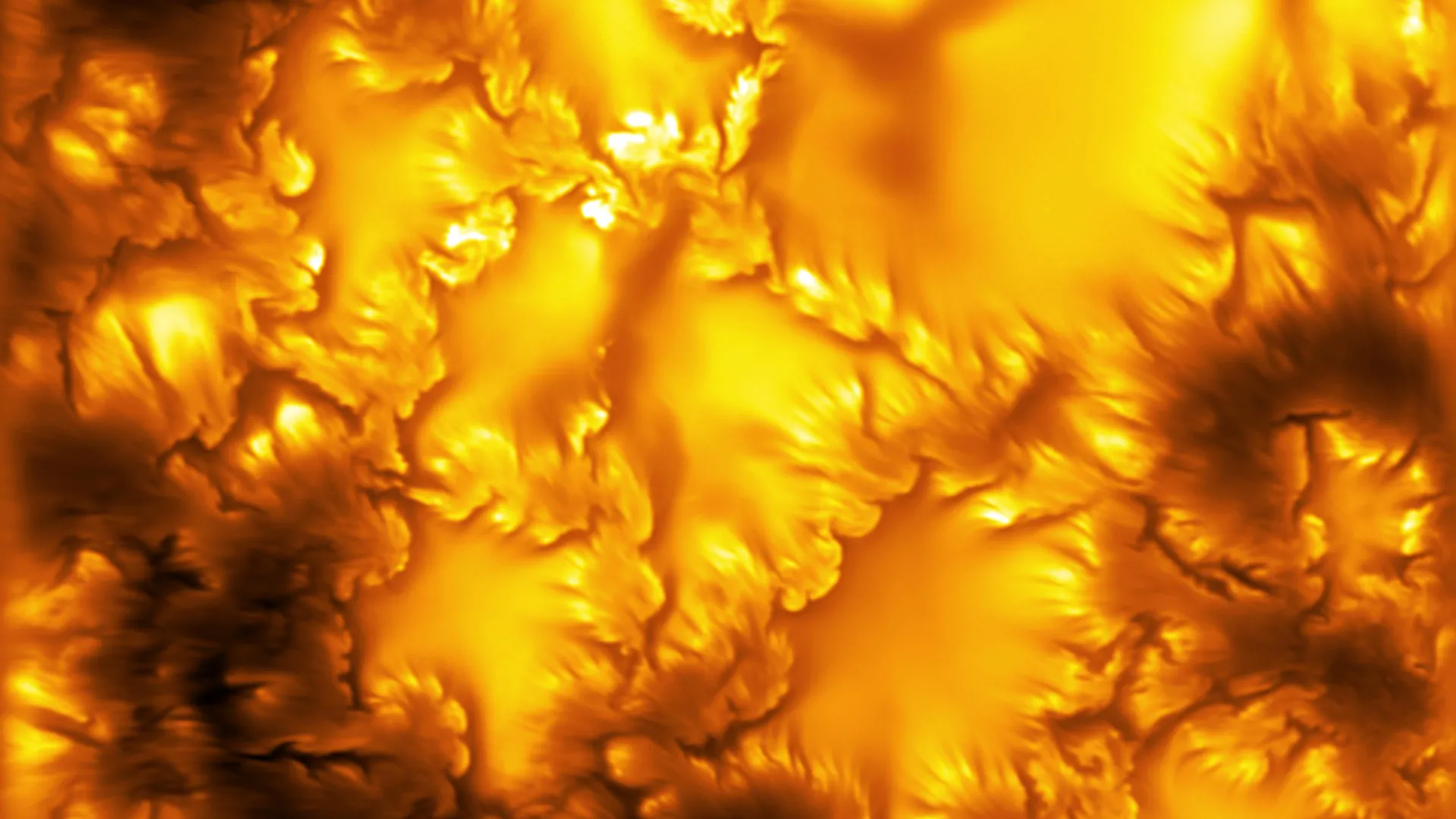
An international team from the NSF National Solar Observatory, the Max Planck Institute for Solar System Research, and the High Altitude Observatory has captured the sharpest images yet of the Sun's surface, revealing plasma whirlpools just 20 kilometers wide swirling along the edges of solar granules.
The vortices were spotted using the Inouye Solar Telescope in Hawaii, the world's largest solar telescope, paired with a broadband imaging camera from the Max Planck Institute and matching computer simulations. Resolving something so small on the Sun is roughly equivalent to spotting a one-euro coin from 180 kilometers away, since individual granules typically span 500 to 2,000 kilometers. The findings, driven by the Kelvin-Helmholtz instability also seen in ocean waves and clouds, were published in Nature.
The vortices appear continuously wherever the magnetic field is strong enough, and researchers believe they help twist and rapidly transport magnetic energy through the solar atmosphere. That could explain how the Sun stores up energy for eruptions and may even shed light on its roughly eleven-year activity cycle, feeding into better space-weather forecasts.