Overview
The Tibetan Spaniel is a small companion dog from Tibet. It is not a gun dog at all; the name probably came from a passing likeness to toy-sized hunting spaniels.
It is a devoted, watchful and independent little dog that bonds closely with its family and likes to keep an eye on the household from a high perch.
History
Small dogs of this type lived in Tibetan monasteries, where they followed the lamas and were seen as little lions, echoing the sacred Snow Lion. They were exchanged as gifts between monasteries and the courts of China and other Buddhist lands, which probably gave them shared ancestry with the Pekingese and Japanese Chin.
They also had useful jobs: sitting on monastery walls as lookouts, raising the alarm alongside the Tibetan Mastiffs below, and even turning prayer wheels. The breed reached Britain by the 1890s, and the FCI recognised it in 1987.
Appearance
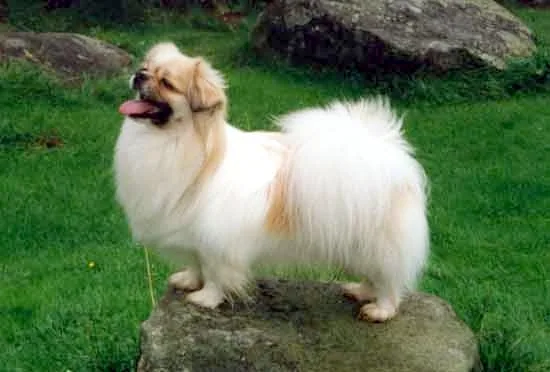
A small, slightly longer-than-tall dog with a domed head, a short blunt muzzle free of wrinkles, and oval eyes set wide apart. The pendant ears are feathered, and a mane of hair circles the neck, most noticeably in males.
The high-set, richly feathered tail curls over the back. Front legs are slightly bowed and the feet are hare-like. The silky double coat lies flat and is smooth on the face and front of the legs.
Temperament
Tibetan Spaniels are social, affectionate and sensitive to their people, and they do not do well when left alone for long stretches. They are protective of the family and usually reserved with strangers, announcing anything unusual with a loud alarm bark.
They are also independent and can be stubborn, with a tendency to wander off and explore rather than come when called. Early socialisation helps them become confident, well-mannered companions.
Care and exercise
Exercise needs are modest: daily walks and play suit them well, in a securely fenced area, as their independent streak makes recall unreliable. They are happiest as part of the household and need plenty of company.
Grooming is manageable, with brushing a couple of times a week and more attention to the feathering on the ears, toes and tail during shedding periods. Positive, patient training works best.
Health
Generalised progressive retinal atrophy occurs in the breed and a DNA test exists. Portosystemic (liver) shunt is rare but reported. Allergies, cherry eye and weeping eyes can also occur. A 2024 UK study found an average life expectancy of about 15 years.