Overview
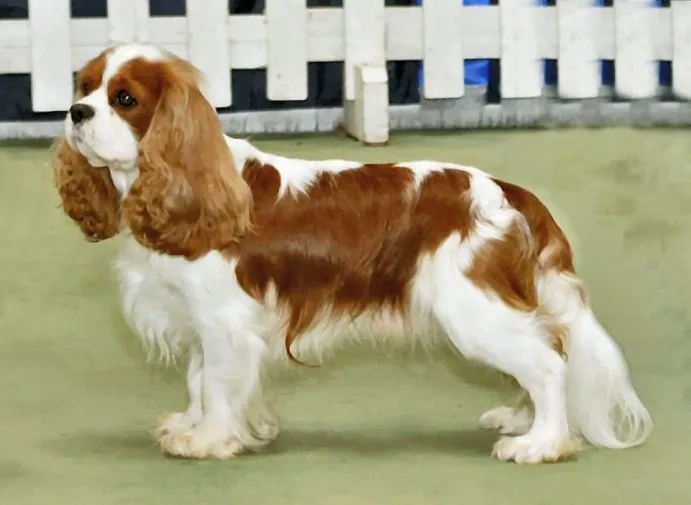
The Cavalier King Charles Spaniel is a small, elegant toy spaniel with a flat skull, long ears and a sweet expression. It is known for its soft, silky coat and four classic colours.
Its easygoing, sociable nature has made it one of the most popular companion breeds in Britain, America and Australia.
History
Toy spaniels were favoured by royalty, including Charles II, and red-and-white ones were kept at Blenheim by the Duke of Marlborough. In the nineteenth century these spaniels were crossed with flat-faced breeds and changed shape.
In 1926 the American Roswell Eldridge offered prizes for dogs of the older, longer-faced type. Breeders took up the challenge and the breed was recognised by the Kennel Club in 1944.
Appearance
A small spaniel with a silky, moderately long coat that is free of curl, though a slight wave is allowed. Feathering grows on the ears, feet, legs and tail. The skull is flat, the ears set high and the muzzle fairly long.
The tail is usually left undocked. Adults weigh about 6 to 8 kg.
Temperament
Playful, patient and eager to please, the Cavalier is happiest in company. Most get on well with children, other dogs and even larger pets.
They are curious and adaptable but dislike being left alone for long periods.
Care and exercise
Moderate daily walks and play are enough, and they enjoy a snuggle on the sofa afterwards. Brush several times a week to keep the feathering free of tangles, and check the ears regularly.
They have a spaniel's chase instinct, so use a lead near roads.
Health
The breed is prone to mitral valve heart disease and syringomyelia, so choose a breeder who health-tests. Ear infections and eye problems can also occur.