Overview
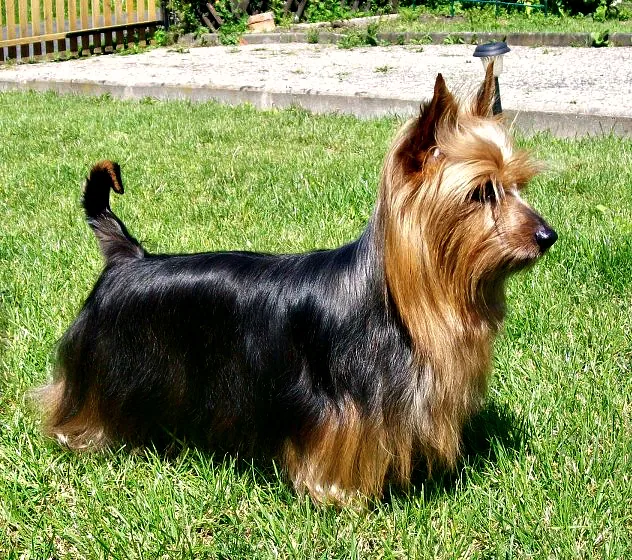
The Australian Silky Terrier is a compact, short-legged terrier known for its fine, glossy, silky coat. It was developed in Australia from British terrier stock and is closely related to the Australian Terrier and the Yorkshire Terrier.
Despite its dainty looks, it is a confident, alert little dog with real terrier character. It makes a lively, affectionate companion for owners who enjoy a small dog with plenty of personality.
History
The breed grew out of crosses between Yorkshire Terriers and Australian Terriers, whose own ancestors were rough-coated terriers brought from Britain in the early 19th century. For a time the three types were not clearly separated, and puppies of different types could appear in one litter.
Early on it was called the Sydney Silky, after the city where it was most common. It was kept mainly as an urban pet, though it also earned a name as a snake and rodent killer. After 1932 further crossbreeding was discouraged, the name Australian Silky Terrier became official in 1955, and American servicemen helped spread the breed to the United States after the war.
Appearance
This is a small, slightly longer-than-tall terrier with a strong, wedge-shaped head, small almond-shaped dark eyes and small erect ears. The tail is set high and the feet are small and almost catlike.
The long, straight, fine coat parts along the back and hangs to above floor length. Colours are blue and tan or grey and tan, with a lighter topknot.
Temperament
Silkies are keen, busy and affectionate, and they bond closely with their people. They are a little more independent than many toy breeds and somewhat calmer than other terriers, but still energetic.
They are clever and quick to learn yet can be stubborn and willful. They bark readily, especially when meeting strangers, and they will chase small animals given the chance.
Care and exercise
A daily walk and some play keep a Silky happy, and it adapts well to apartment life. Training should be consistent, short and rewarding, started early with good socialisation.
The coat needs regular brushing to stay silky and free of tangles, with occasional trimming of the face and ears. A securely fenced garden is wise because of the strong chase instinct.
Health
Generally a sturdy small breed. A UK study put average life expectancy at about 13 years. Like many small dogs it can be prone to knee cap problems, dental issues and some skin or digestive sensitivities, so routine veterinary care is useful.