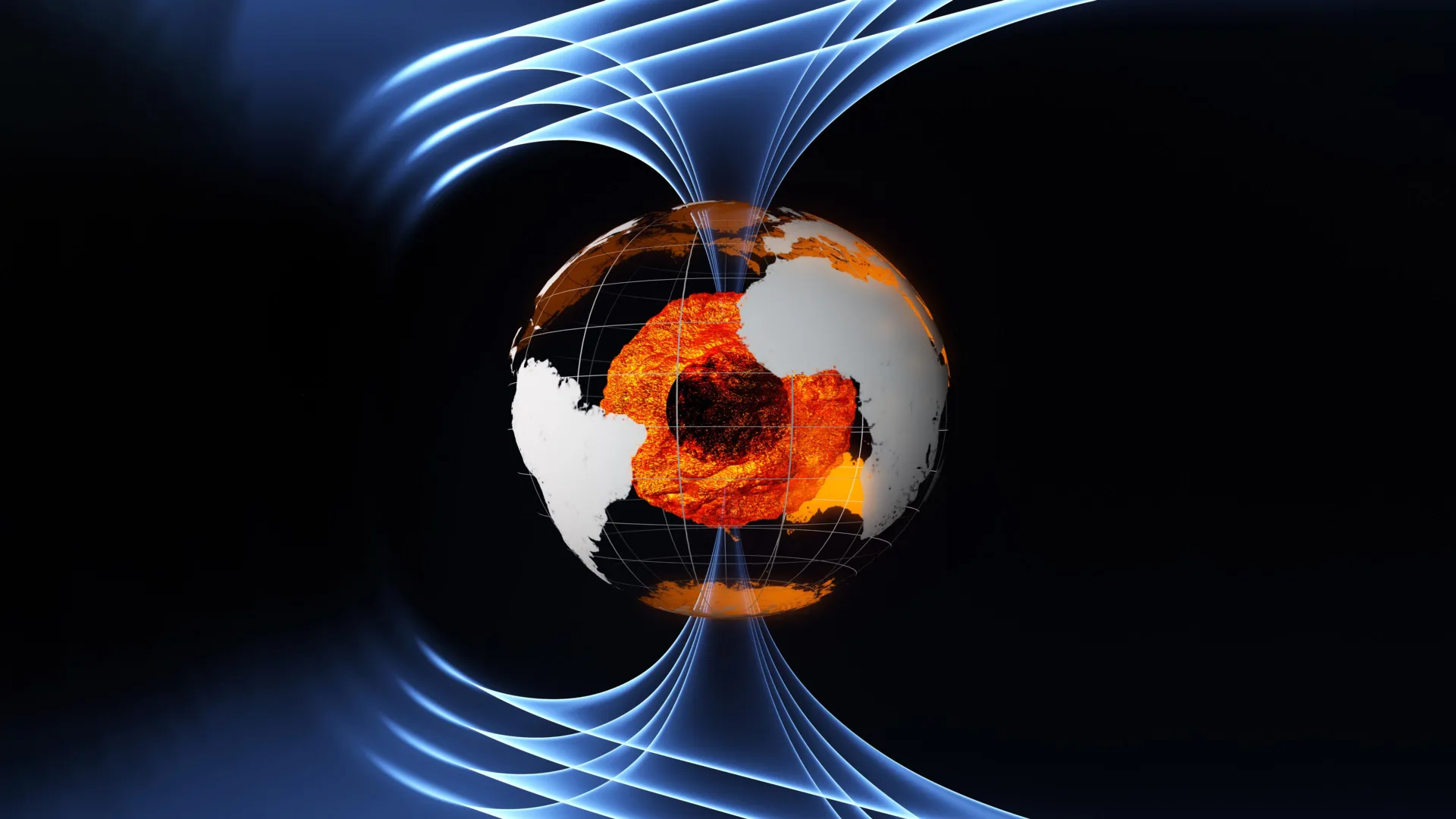
A vast region of Earth's liquid iron outer core, roughly 2,200 km beneath the Pacific Ocean, abruptly switched from a weak westward drift to a strong eastward flow in 2010 — and scientists still do not know why. The finding comes from a new study led by Frederik Dahl Madsen of the University of Edinburgh's School of Geosciences, published in the Journal of Studies of Earth's Deep Interior.
Researchers combined ground-based observations with nearly three decades of satellite magnetic data (1997-2025) from ESA's Swarm and CryoSat missions, plus Germany's CHAMP and Denmark's Ørsted missions, to reconstruct the hidden currents deep inside the planet. The outer core acts like the spinning conductor in a bicycle dynamo, generating the electric currents that sustain Earth's magnetic field, so unexpected shifts in its flow challenge assumptions that core circulation stays relatively stable over human timescales.
The team's model also shows the eastward flow has been weakening again since 2020, hinting the reversal may not be permanent. "The large-scale flow reversal beneath the Pacific raises new questions about the behavior of Earth's deep interior," Madsen said. Understanding these deep currents matters because they ultimately shape the magnetic field that shields the planet from solar radiation.