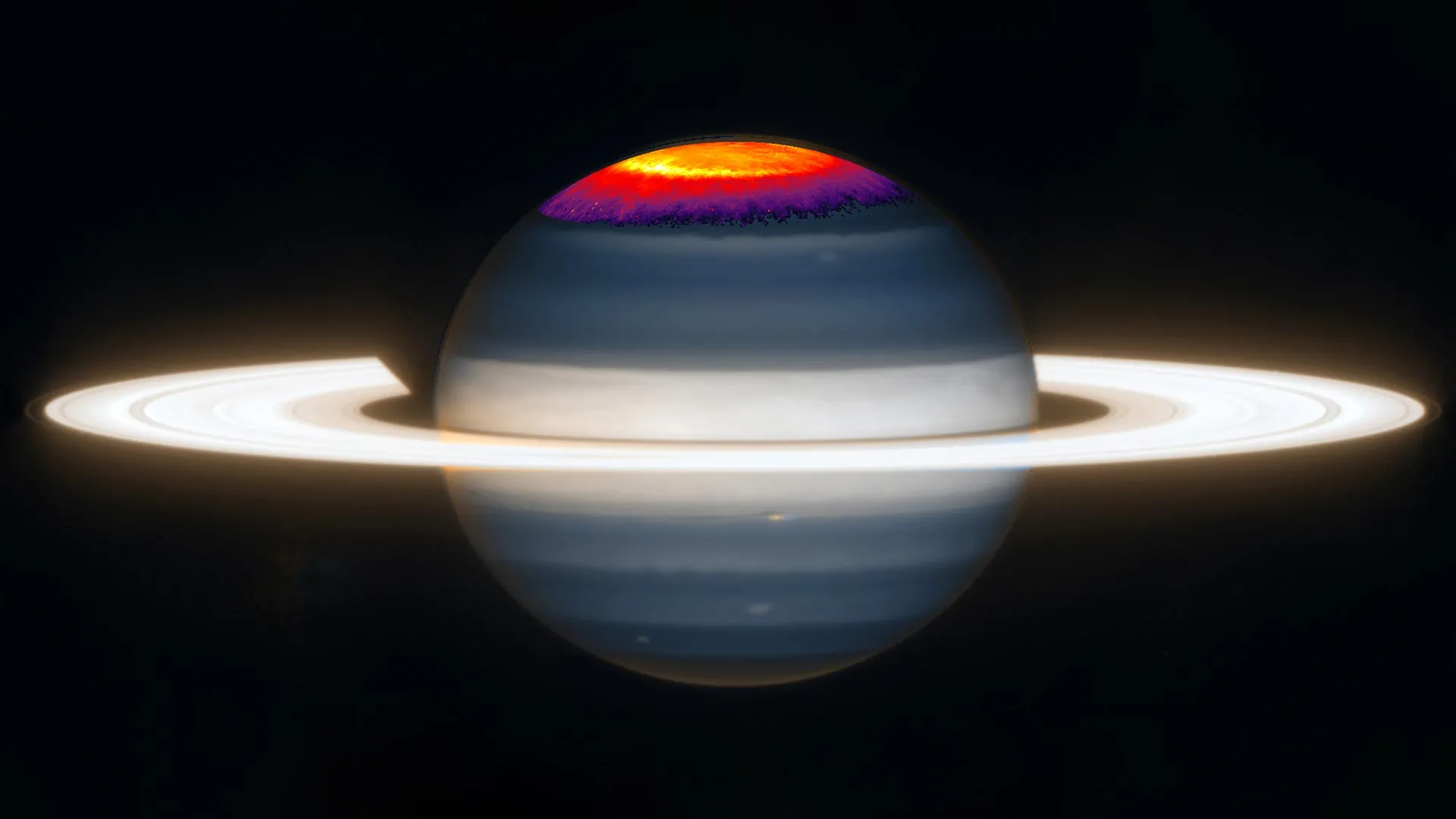
Astronomers led by Professor Tom Stallard of Northumbria University have cracked a puzzle that dates back decades: why Saturn appears to change its rotation rate. The answer, revealed by the James Webb Space Telescope, is that the planet never sped up or slowed down at all. Powerful winds high in its atmosphere, driven by the aurora, distorted every measurement.
Webb watched Saturn's northern auroral zone continuously for one full Saturnian day, mapping infrared light from trihydrogen cations to chart temperatures and charged-particle densities about ten times more precisely than before (earlier readings carried a ~50C uncertainty). The data exposed a self-sustaining loop the team calls a planetary heat pump: the aurora heats the atmosphere, the heat drives winds, the winds generate electrical currents, and those currents power the aurora all over again.
The mystery gained urgency after NASA's Cassini probe suggested in 2004 that Saturn's spin was drifting. Stallard's group first proposed an atmospheric explanation in 2021, and the new Webb observations, published May 29, 2026, finally confirm it, reshaping how scientists read the rotation and magnetosphere of giant planets.