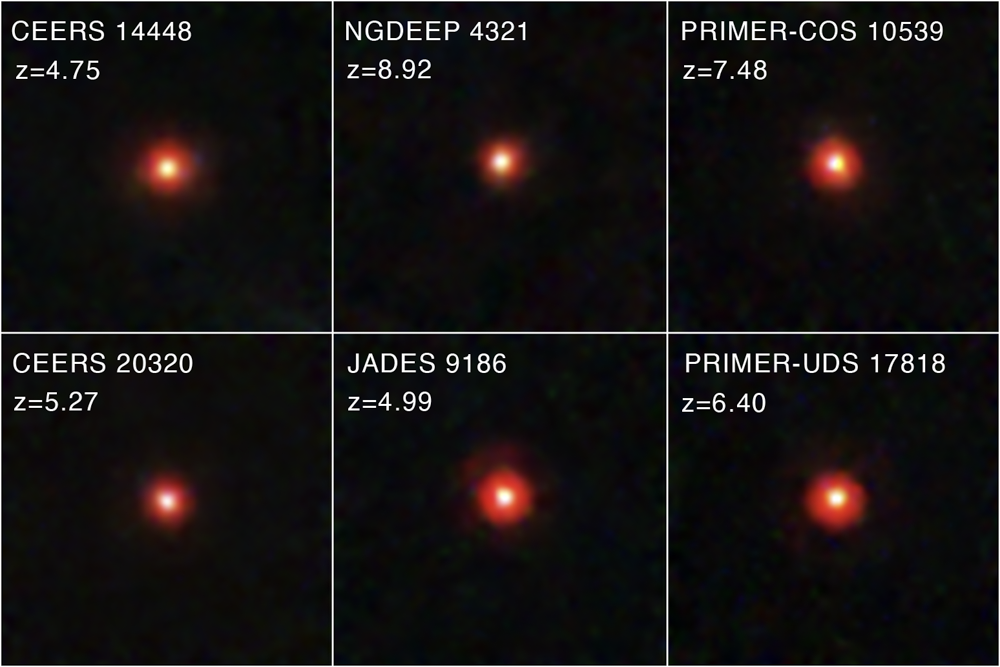
Researchers at the University of Portsmouth, led by Dr Daniel Whalen, say the “Little Red Dots” seen by the James Webb Space Telescope are most likely primeval galaxies hosting massive black holes. Their cosmological simulations, published in The Astrophysical Journal Letters, show the black holes forming from the collapse of supermassive primordial stars.
The black holes, of about 10 million solar masses, stay embedded in dense gas discs that trap high-energy X-rays while letting some ultraviolet, visible and infrared light escape. A neighbouring cluster of roughly 100 million stars within about 500 light-years supplies the blue part of the spectrum. The model reproduces many observed Little Red Dots, including some of the most distant.
It matters because the objects have puzzled astronomers since Webb found them. Competing explanations exist, such as young black holes wrapped in gas cocoons, so the question is not settled.