Overview
The Swedish Vallhund is a small, sturdy herding dog from the Swedish province of Västergötland. Its name simply means herding dog, and it was used for centuries to drive cattle and guard farms.
Today it is a lively, clever companion that thrives on activity and sports, and suits active owners who like a small dog with big energy.
History
The breed is thought to date back more than a thousand years, perhaps to the Viking era, and may have played a part in the development of the Welsh Corgi and the Lancashire Heeler. It is related to the larger spitz and elkhound types of Scandinavia.
Numbers fell to near extinction by the 1940s. Björn von Rosen and K. G. Zettersten revived the breed, and the Swedish Kennel Club recognised it in 1943.
Appearance
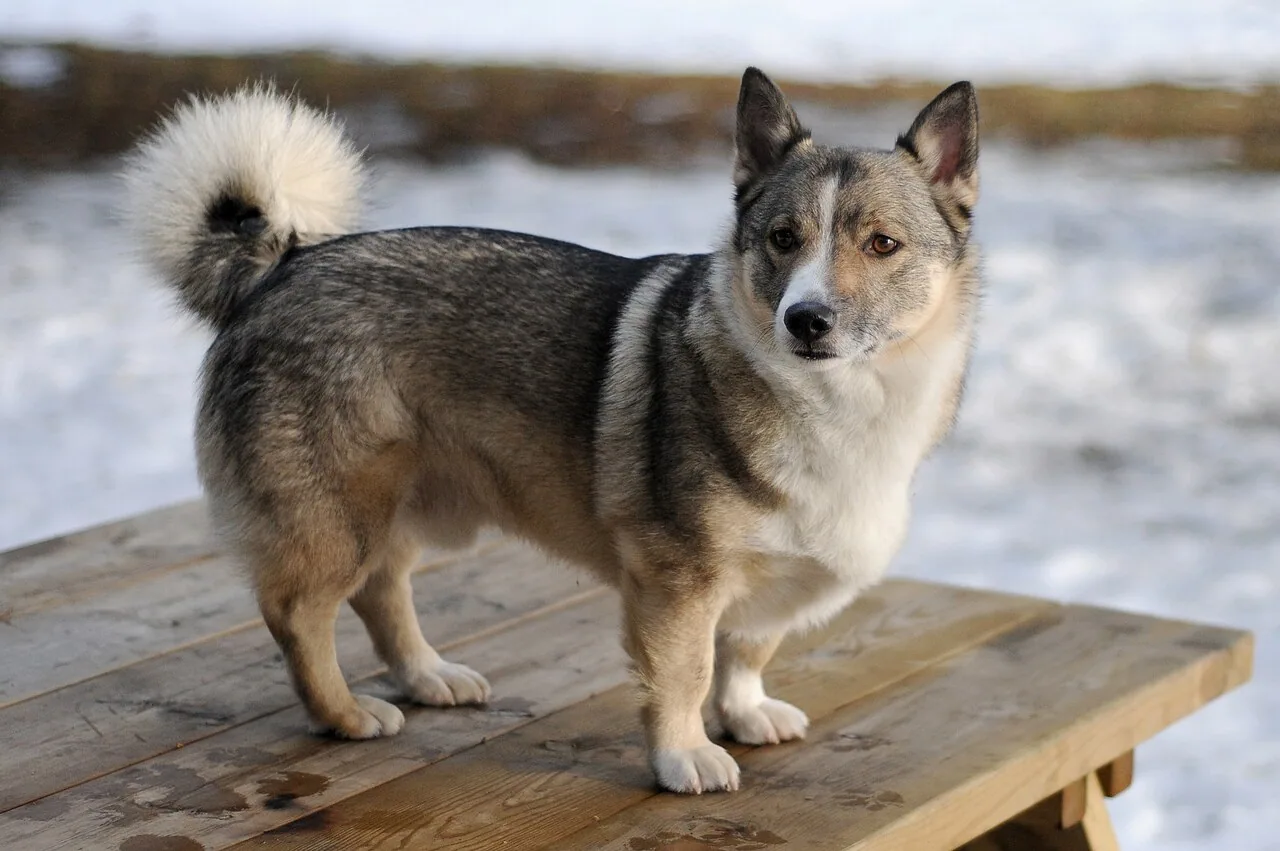
A long-bodied, short-legged dog with a wedge-shaped head, dark oval eyes and pricked ears. Males stand about 33 cm and females about 31 cm at the withers, and the body is roughly one and a half times as long as tall.
Puppies are born with tails from none at all to full length. The harsh double coat is grey, greyish brown, greyish yellow or reddish brown, with lighter harness markings on the shoulders.
Temperament
Alert, intelligent and eager to work, the Vallhund bonds closely with its family and loves having a job. It is friendly, bold and sometimes bossy, and may try to herd children or other pets by nipping at their heels.
It is a good watchdog that barks to announce visitors, and it learns quickly with positive, consistent training.
Care and exercise
Plenty of daily exercise and mental work suit this breed well. Agility, obedience, tracking and herding trials are all good outlets, and without activity it may become bored and noisy.
The weather-resistant double coat is easy to care for with weekly brushing, with more during seasonal sheds. It copes with heat if given shade and water, but deep snow is hard on its short legs.
Health
Generally healthy and long-lived, with an average lifespan of about 15 years. An inherited form of progressive retinal atrophy occurs in the breed, causing mild to moderate night blindness around ten years of age, so eye testing of breeding dogs is advised.