Overview
The Mi-Ki is a small companion breed developed in the United States in the 1980s by a Wisconsin breeder. It comes in a long-coated variety with facial furnishings and a smooth-faced variety.
It is calm, quiet and sociable, and is also used for therapy work.
History
The breed is credited to Maureen van Wormer, who began crossing small dogs on a Shih Tzu base and later added Papillon, Maltese, Yorkshire Terrier and Japanese Chin. Early records were not kept, and pedigrees were lost in a fire in 1995, so the exact mix is unknown.
Several independent clubs and registries formed in the 1990s and 2000s, each with closed studbooks. The United Kennel Club recognised the breed in 2016.
Appearance
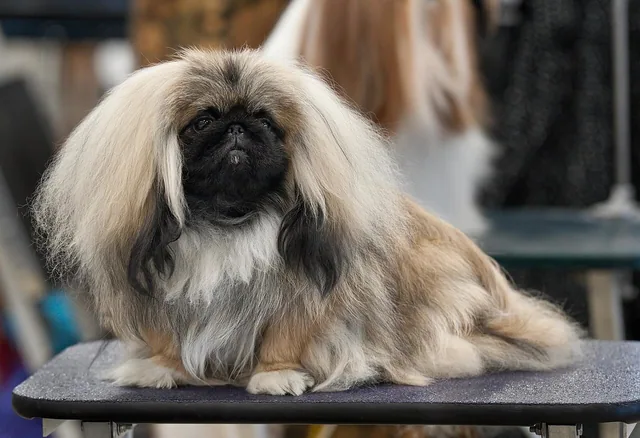
A small, fine-to-medium-boned toy dog, slightly longer than tall, with a rounded head, short muzzle and large, dark, round eyes. The ears may be dropped or erect and can wing outward when the dog is alert.
The silky single coat is long with a moustache and beard in one variety, and short on the face in the smooth-faced variety.
Temperament
Mi-Kis are gentle, calm and friendly, and usually sociable with people and other animals. They tend to bark less than many toy breeds.
They enjoy being close to their family and suit quiet homes well, which also makes them good therapy dogs.
Care and exercise
Daily short walks and indoor play are enough. The long coat needs regular brushing to prevent matting, while the smooth-faced variety is easier.
Like other toy dogs, they need gentle handling, dental care and protection from cold.
Health
Reported conditions include patellar luxation, progressive retinal atrophy, heart conditions such as patent ductus arteriosus, hyperuricosuria and disc disease. Health screening of breeding stock is recommended.