Overview
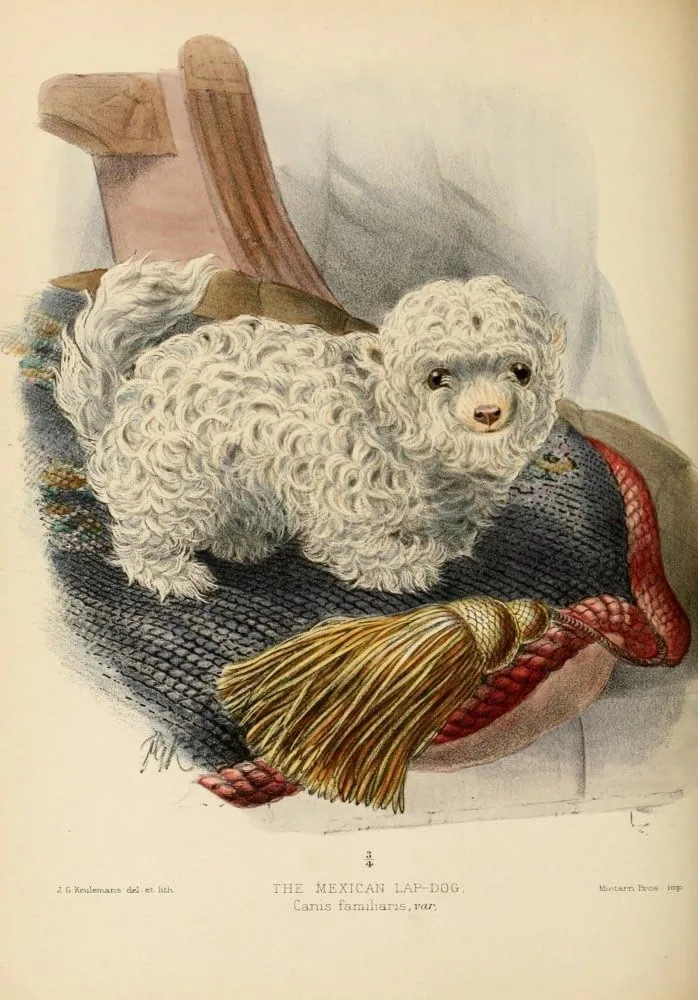
The Mexican lapdog, or Ytzcuinte potzotli, was a tiny white lapdog said to come from Mexico. It was reputedly smaller than any other known breed, including the Chihuahua.
Its story is murky. It was kept as a curiosity rather than a working dog, and later writers questioned whether it was ever a true breed at all.
History
Its foundation stock is unknown, though it is thought to have descended from European breeds. Victorian writers described it as a curiosity of no practical use, and it died out.
Victorian taxidermists often mounted puppies and sold them as tiny adult dogs, and Mexican lapdog puppies were popular subjects. One bought in Liverpool in 1843 was displayed in the British Museum and is now at the Natural History Museum at Tring. Later authors suggested the breed may have been mostly mounted puppies of other breeds.
Appearance
Reported to be about the size of a guinea pig, with puppies the size of hamsters. The only surviving mounted specimen measures about 18 cm from nose to tail base and 8 cm at the shoulder, though its maturity is unverified.
The coat was white and medium length, with longer hair on the short tail. It had a round head, small ears, a flesh-coloured nose and wide-set brown eyes. There were silky and woolly varieties; the woolly one, the Mexican mopsy, was more popular.
Temperament
Almost nothing reliable is recorded about its temperament. It was kept purely as a pet and curiosity, not for work or sport.
Care and exercise
As a breed that no longer exists, there is no care to describe. Any dog that tiny would have been extremely fragile and needed warmth, gentle handling and close protection.