Overview
The Lithuanian Hound is a rare, medium-sized hunting dog and the only breed that originates in Lithuania. It was traditionally used to hunt hare, fox and boar.
It is sturdy yet sleek, energetic and responsive to training. It is not recognised by the FCI.
History
The breed is believed to come from bloodhounds mixed with other hounds, and it dates to the medieval Grand Duchy of Lithuania. It was first mentioned in 1541 and appears in the Statutes of Lithuania of 1588.
After World War II only 78 dogs remained. Enthusiasts revived it, a provisional standard was set in 1966, and numbers reached about 350 by 1987 before falling to around 150 by 1998. Changing hunting habits and inbreeding are concerns.
Appearance
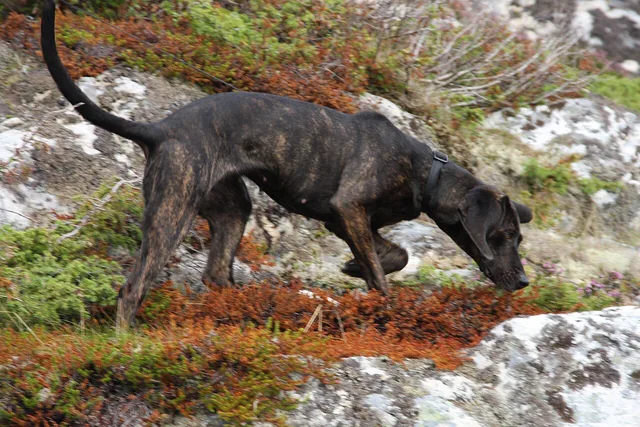
Sturdy and heavy-boned, yet sleek and muscular. The coat is short, thick and black with tan on the muzzle, chest, ears and forehead; a small white chest spot is allowed. The head is large, the chest broad and deep, and the long ears hang close to the cheeks.
The long tail is sword-shaped and carried low, and the feet are round and compact.
Temperament
These hounds are energetic, agile and determined pursuers, and they respond well to training. They are best suited to hunting large animals over large open areas.
Care and exercise
They need rigorous daily exercise and plenty of space, and are not suited to cramped living. The short coat is easy to care for with occasional brushing. Check the long ears regularly.
Health
Because the population is small, inbreeding is a real concern for breeders. A 2008 study calculated the inbreeding coefficient at 2.09 percent.