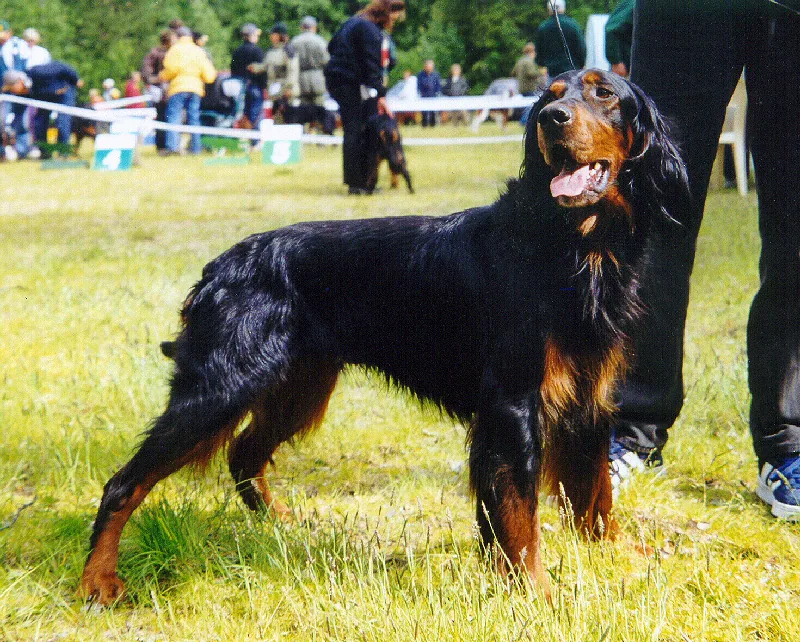
Overview
The Gordon Setter is a Scottish bird dog, the heaviest and most powerful of the setter breeds. It was developed to find and point game birds such as grouse and partridge over open moorland.
Today it is also a loyal family companion. It is intelligent and affectionate but needs a lot of exercise and gentle, firm handling.
History
Setters are thought to descend from old land spaniels, perhaps with some influence from pointers and hounds. Black and tan setters were kept in many kennels, notably those of the Duke of Gordon, who gave the breed its name in the early nineteenth century.
The Kennel Club officially applied the name Gordon Setter in 1924. The breed reached the United States in 1842 and was recognised by the American Kennel Club in 1892. Changes in shooting and farming in the twentieth century reduced the number of working setters.
Appearance
A big, sturdy and dignified dog with a coal-black coat and rich chestnut or mahogany markings on the muzzle, throat, chest, legs and above the eyes. A little white is allowed on the chest.
The coat is long, silky and straight or slightly wavy, with feathering on the ears, legs, belly and tail. Males can reach about 69 cm and 36 kg.
Temperament
Gordons are intensely loyal, affectionate and eager to learn, though they can be strong-minded and sensitive. They do best in an attentive home with firm but gentle handling and early socialisation.
Puppies and adults are boisterous and slow to mature, often not at their prime until about three years of age. They may be too exuberant for very young children.
Care and exercise
Gordons were bred to run and need about an hour or more of vigorous exercise each day. Avoid over-exercising young dogs or starting agility before about 18 months. They should not roam off lead unsupervised, as scent can lead them into danger.
Brush the silky coat several times a week to prevent tangles and keep the feathering and ears clean.
Health
Conditions seen include hip dysplasia, hypothyroidism, bloat (gastric torsion) and eye diseases such as progressive retinal atrophy and cataracts. A DNA test exists for a late-onset form of PRA. A 2024 UK study found life expectancy of about 12.4 years.