Overview
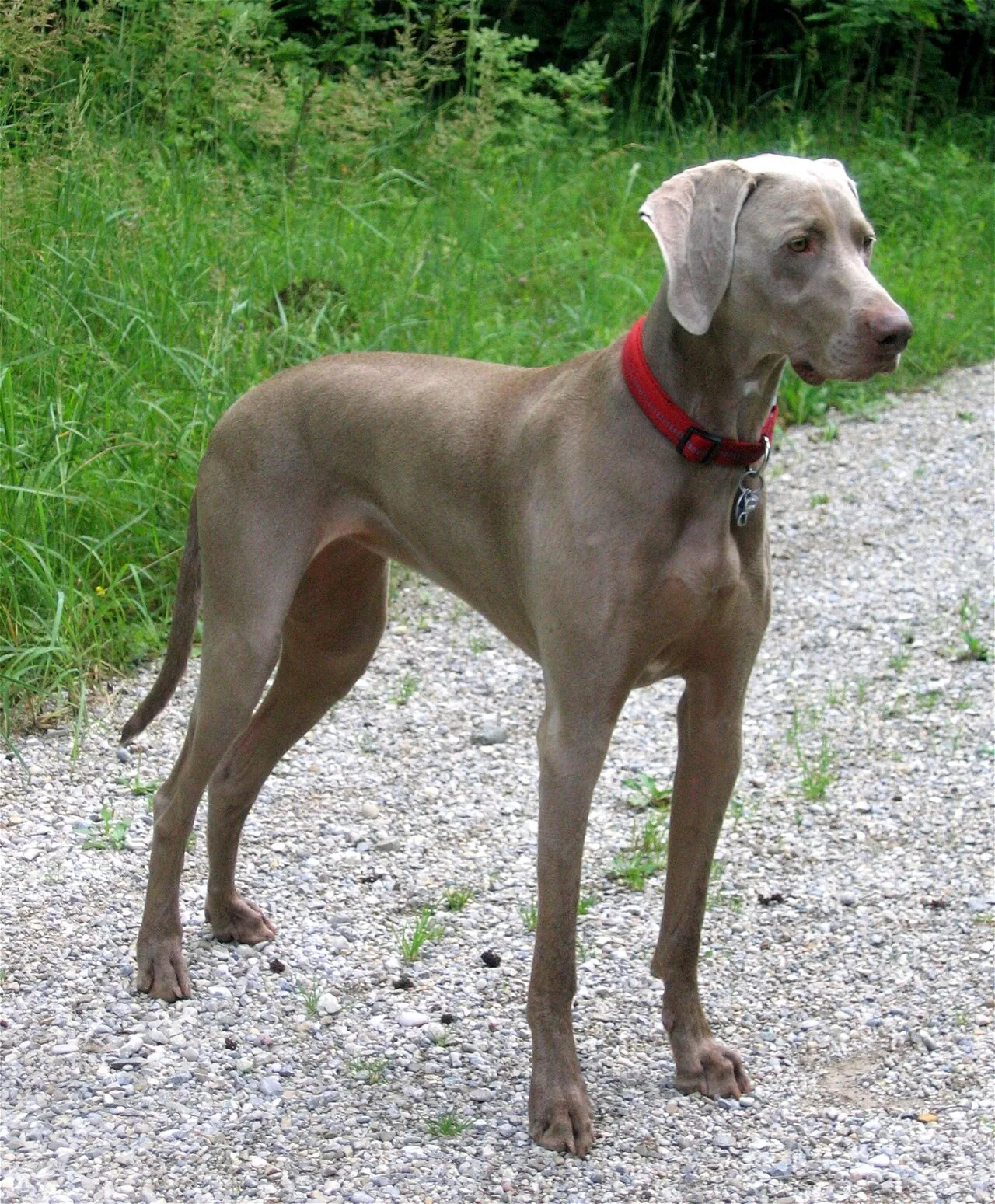
The Weimaraner is a medium to large German hunting dog named after the city of Weimar. It is an all-purpose gun dog with speed, stamina, a good nose and courage.
In Germany it is not considered a companion dog and is placed mostly with hunters. Elsewhere it needs an active owner who can give it a job.
History
Silver-grey dogs appear in paintings from the seventeenth and eighteenth centuries, and the breed is believed to come from the Weimar area. From 1879 they were treated as a blue variant of the German Short-haired Pointer.
The Weimaraner was recognised as a distinct breed in 1891, and a breed club was founded in 1897. It nearly died out in the early twentieth century and was rebuilt from a few survivors. The FCI accepted it in 1954.
Appearance
A medium to large, athletic dog standing 57 to 70 cm, with males weighing 30 to 40 kg and females 25 to 35 kg. The ears are long and hanging with rounded tips, and the eyes are amber.
The coat may be short or long and is mouse-grey, roe-grey or silver-grey. Small white markings on chest and feet are tolerated.
Temperament
Intelligent, courageous and driven, with great stamina. It bonds closely with its people and is happiest when working alongside them.
Without enough activity and purpose, it may become restless and destructive.
Care and exercise
It needs lots of daily exercise and mental work, ideally hunting, tracking or similar sport. Early training and socialisation are important for such a strong and clever dog.
Grooming is easy: regular brushing is enough, whether the coat is short or long.
Health
Reported conditions include cerebellar hypoplasia, spinal dysraphism, entropion, distichiasis, corneal problems, demodicosis and tricuspid dysplasia. A 2024 UK study gave a median lifespan of 12.8 years.