Overview
The Bracco Italiano is the traditional pointer of the Italian peninsula, a powerful and elegant gundog with a noble, slightly sad expression. It was bred to find game and indicate it for the hunter.
Away from the field it is a sweet, people-oriented companion. It suits active owners who can offer plenty of exercise and close human company.
History
Dogs resembling the Bracco appear in Italian paintings as far back as the fourteenth century, making it one of the oldest pointing types in Europe. The first dog entered in the Italian kennel club's stud book in 1882 was a Bracco.
Two types once existed, a heavier noble type and a lighter, smaller one. A standard for the larger type was written in the 1890s, a national standard followed in 1949 and the breed was accepted by the FCI in 1956.
Appearance
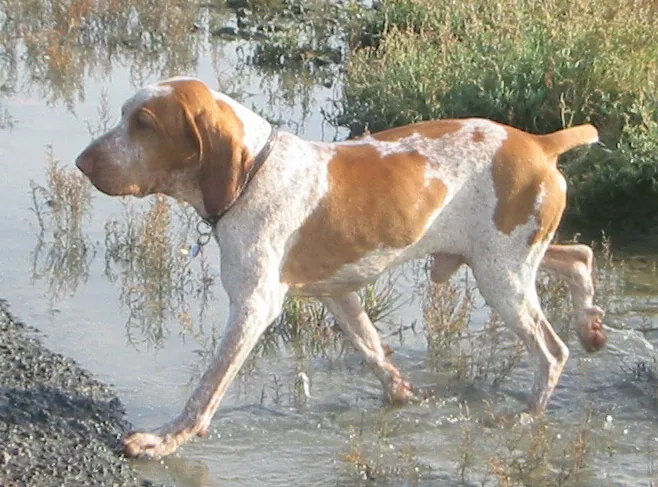
A roughly square, strongly built dog with a large head, long hanging ears and loose upper lips that fall below the lower jaw. Males stand 58 to 67 cm and females 55 to 62 cm, weighing about 25 to 40 kg.
The coat is short, dense and glossy. It is white, white with orange or amber patches, or chestnut roan.
Temperament
Bracchi are calm, affectionate and eager to please, and usually gentle with family members. They are sensitive dogs that respond better to patient, kind training than to harsh correction.
They bond closely with their people and dislike being left alone for long periods. With good socialisation they get along well with children and other dogs.
Care and exercise
This is a working gundog and needs a good amount of daily exercise, ideally with room to run and chances to use its nose. Mental activity such as scent games keeps it content.
Grooming is simple: a weekly brush and regular checks of the long ears and the loose lips, which can collect dirt and moisture.
Health
Hip dysplasia is a known concern, as with many large breeds. The long, hanging ears can be prone to infection, and deep-chested dogs can be at risk of bloat, so feed several smaller meals and avoid hard exercise right after eating.