Overview
The Entlebucher is a compact, muscular Swiss herding dog and the smallest of the four Sennenhund breeds. It was developed in the Entlebuch region of the canton of Lucerne, and the name Sennenhund refers to the Alpine herders known as Senn.
Originally kept for herding and guarding, it is now mostly a lively family companion for active people who enjoy training and outdoor activity.
History
In the 1800s the Swiss mountain dogs were variable and not seen as separate breeds. The Swiss Kennel Club began classifying them in 1908, and in 1913 four bobtailed Entlebuchers were shown to Albert Heim, a champion of the rare Sennenhund types.
World War I disrupted the work, and few dogs could be found afterwards. A breed club formed in 1926, sixteen dogs were located in 1927, and the breed was slowly rebuilt. The American Kennel Club admitted it to its stud book in 2010.
Appearance
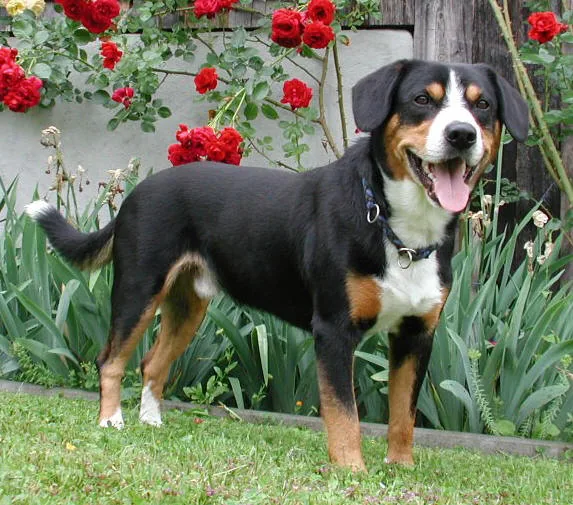
A sturdy, medium-sized dog, slightly longer than tall in males and more square in females, with small triangular ears, rather small brown eyes and a strong, flat skull. The body is muscular, with compact feet and broad hips.
The short, smooth coat is tricolour: black with symmetrical tan and white markings, tan always between black and white. The tail may be a natural bobtail or, historically, docked.
Temperament
Entlebuchers are good-natured and devoted to the people they know, and slightly suspicious of strangers. They are bright, energetic and eager to work, with a strong herding instinct that may show up in nipping or chasing.
Early socialisation and consistent training are important. They thrive when given regular activity and a purpose, and can become restless or noisy if bored.
Care and exercise
This is an active breed that needs substantial daily exercise, ideally with mental work such as obedience, agility or herding. A securely fenced garden and an active household suit it best.
The short coat is easy to keep: weekly brushing is generally enough, with more during seasonal shedding.
Health
The small founding population led to inbreeding problems. Hip dysplasia is the most common concern, and progressive retinal atrophy and hemolytic anemia also occur. Breed clubs promote health screening and genetic testing.