Overview
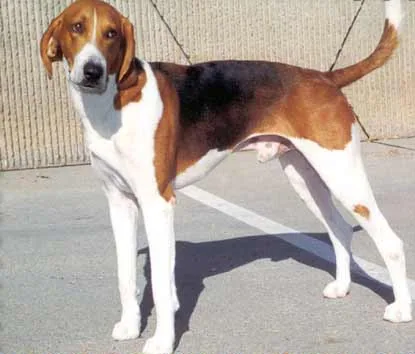
The American Foxhound was bred purely to hunt foxes by scent, and it is closely related to the English Foxhound. It is taller and rangier than its English cousin, and fast, with great stamina.
At home it is mild and friendly, but its voice and love of running make it a poor fit for city life.
History
In 1650 Robert Brooke brought a pack of hounds from England to Maryland, founding the bloodlines known as Brooke Hounds. George Washington then bred for greater speed, using French hounds given by the Marquis de Lafayette along with dogs from Philadelphia and England.
Irish Foxhounds were later added for speed and stamina. The breed was recognised by the American Kennel Club in 1886 and is the state dog of Virginia. Several strains exist, including Walker, Calhoun, Goodman, Trigg, July and Penn-Marydel.
Appearance
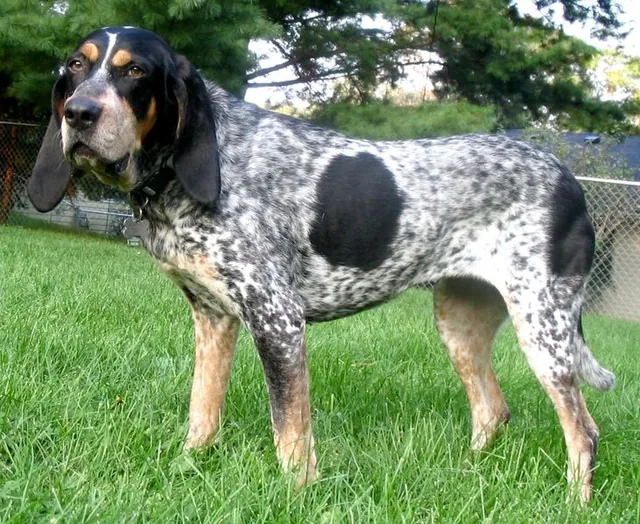
The American Foxhound has long, straight-boned legs, a rather narrow chest, a long muzzle and a large domed skull. The ears are broad and low-set, and the eyes are large, wide-set and hazel or brown.
The standard calls for 53 to 64 cm at the withers, though many dogs, especially show lines, are taller at up to 74 cm. Weight is typically 20 to 32 kg.
Temperament
Foxhounds are docile, sweet and easygoing, and generally get along with children and other animals. They are pack-minded and independent.
Once on a scent they may ignore commands, so patient training is essential and they should not be trusted off the lead. They are not good watchdogs.
Care and exercise
These are very active dogs with high energy and need long daily runs and a secure, fenced space. Weekly brushing handles the short hound coat and keeps shedding in check.
The musical bay can carry for miles, which matters for neighbours. Keep an eye on food intake, as they put on weight easily.
Health
The breed is generally free of widespread inherited disorders. Thrombocytopathy, a platelet problem causing excessive bleeding, is a minor risk, and hip dysplasia and eye issues are beginning to appear occasionally. They gain weight easily if overfed. Lifespan is typically 10 to 12 years.