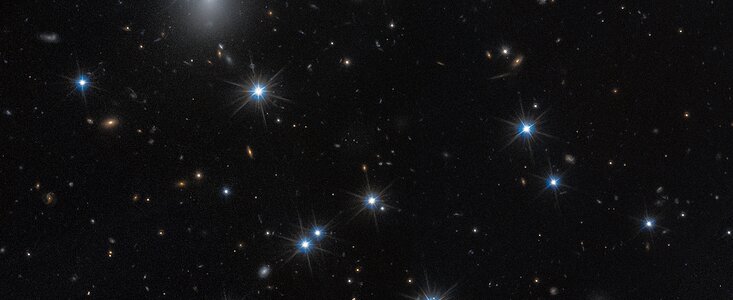
NASA's Hubble Space Telescope, working alongside ESA's Euclid observatory and the ground-based Subaru Telescope in Hawaii, has identified one of the darkest galaxies ever found. Dubbed CDG-2, the dim object lurks 300 million light-years away in the Perseus galaxy cluster and appears to be composed of 99% dark matter.
A team led by David Li at the University of Toronto discovered CDG-2 by searching for tight groupings of globular clusters — ancient balls of stars that orbit galaxies. It marks the first galaxy ever detected solely through its globular cluster population. Follow-up imaging revealed a faint, diffuse glow surrounding the star clusters, confirming a hidden galaxy with the luminosity of roughly 6 million suns, where globular clusters account for 16% of its visible content.
Scientists believe CDG-2 lost most of its normal star-forming hydrogen gas through gravitational interactions with neighboring galaxies inside the dense Perseus cluster, leaving behind a massive dark matter halo with almost no visible stars. The finding, published in The Astrophysical Journal Letters, opens a new method for hunting these invisible cosmic structures.