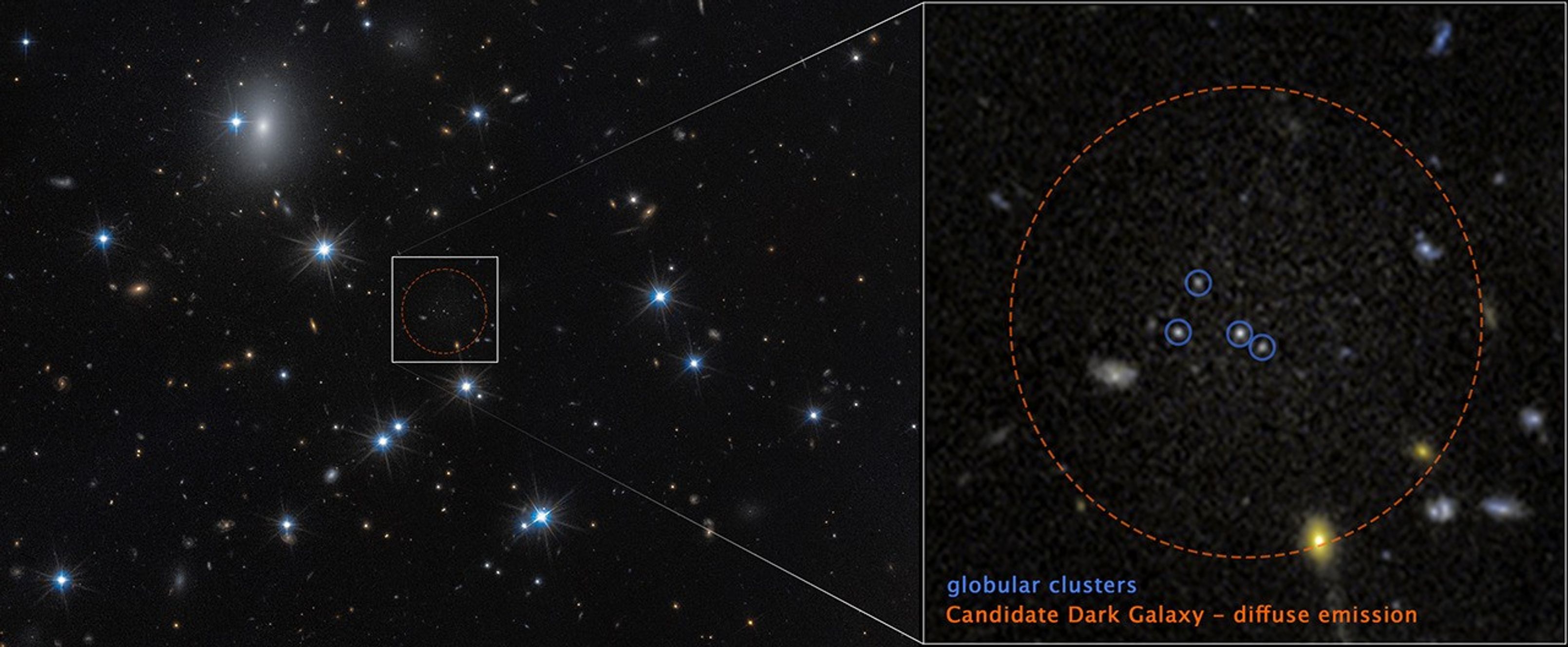
NASA's Hubble Space Telescope has identified CDG-2, one of the darkest galaxies ever found, lurking in the Perseus galaxy cluster about 300 million light-years from Earth. The object is composed of approximately 99% dark matter, with only a sparse scattering of faint stars producing the luminosity of roughly 6 million suns.
David Li of the University of Toronto detected the galaxy using a novel technique — searching for tight groupings of globular clusters rather than looking for starlight directly. CDG-2 is the first galaxy ever discovered solely through its globular cluster population, with four such clusters accounting for 16% of its visible content.
Confirmation required a trio of observatories: Hubble, ESA's Euclid space telescope, and the ground-based Subaru Telescope in Hawaii. Scientists believe much of CDG-2's hydrogen gas was stripped away by gravitational interactions with neighboring galaxies inside the dense Perseus cluster, leaving it unable to form new stars. The findings were published in The Astrophysical Journal Letters.