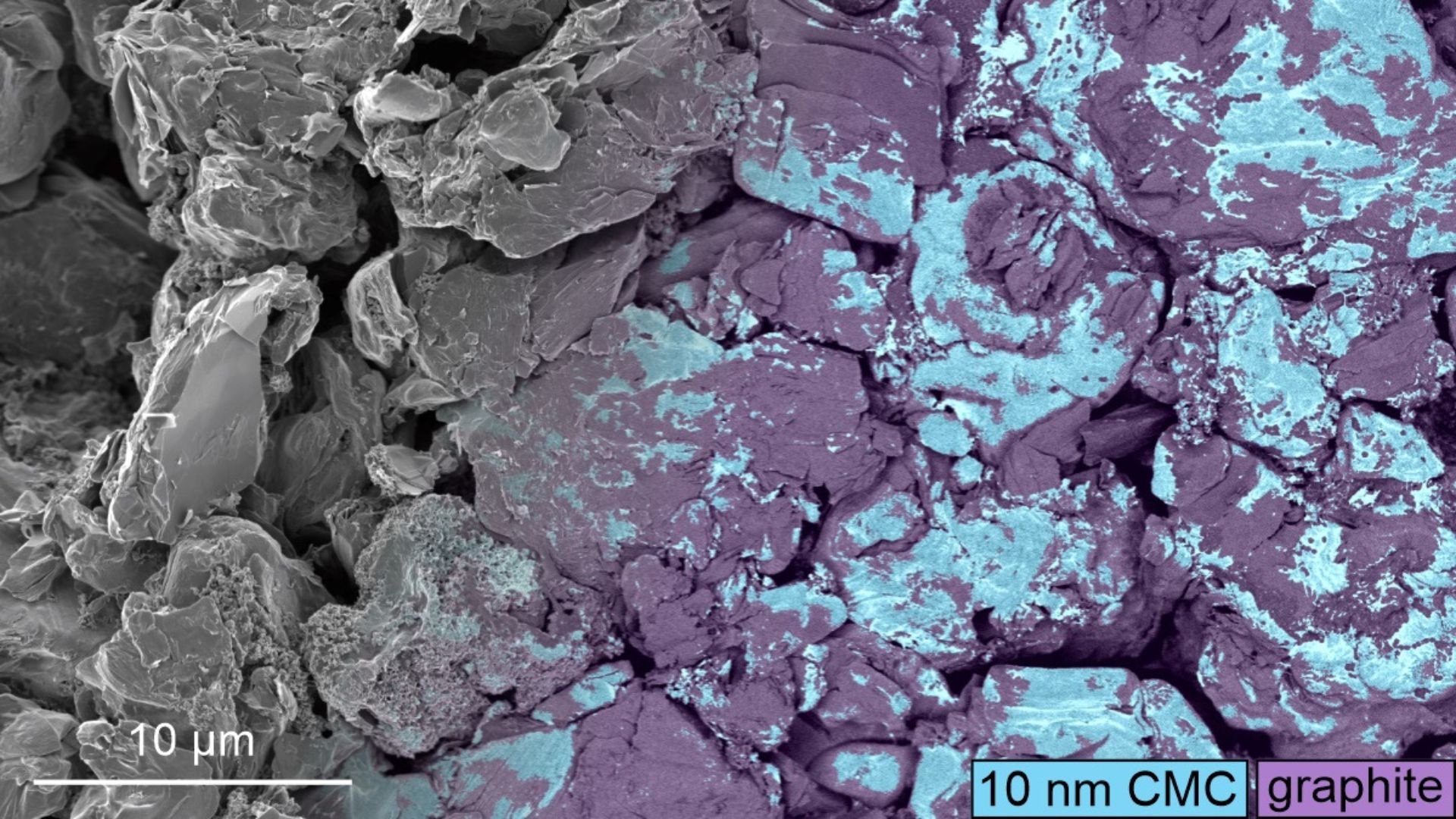
Researchers at the University of Oxford have developed a pioneering technique to visualize polymer binders — the invisible "glue" holding lithium-ion battery electrodes together — for the first time at nanoscale resolution. By tagging binders with silver and bromine markers, the team led by Stanislaw Zankowski revealed how these materials, which make up less than 5% of electrode weight, critically affect charging speed and battery lifespan.
The breakthrough, published in Nature Communications on February 17, showed that small adjustments to manufacturing processes could reduce internal ionic resistance by up to 40%, potentially unlocking significantly faster charging. The imaging also revealed that what starts as a uniform 10-nanometer binder coating can fragment into uneven patches during electrode processing — a previously unseen degradation mechanism.
"For the first time, we can accurately see the distribution of these binders not only generally but also locally, as nanoscale binder layers and clusters," said Zankowski. The technique works across graphite, silicon, and SiOx electrodes, making it broadly applicable to current and next-generation battery designs.