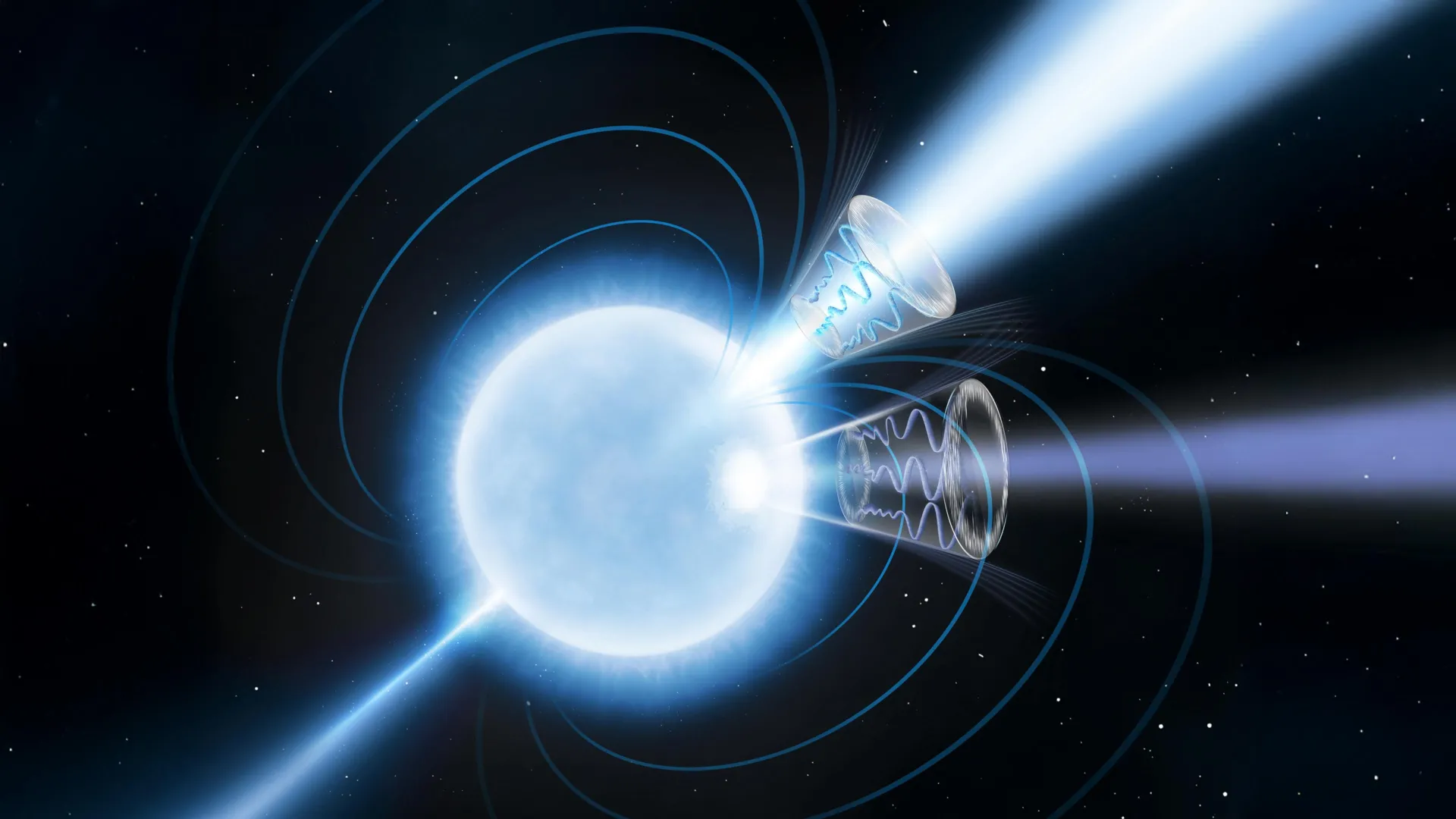
Astronomers say they may have caught "empty" space bending light, confirming a quantum effect predicted by Werner Heisenberg nearly 90 years ago. The finding centers on vacuum birefringence — the idea that a vacuum isn't truly empty but full of virtual particles that briefly pop in and out of existence, subtly distorting light that passes through a strong enough magnetic field.
Led by Rachael E. Stewart of George Washington University with Dr. Marcus Lower of Swinburne University of Technology, the team studied magnetar 1E 1547.0-5408 using NASA's IXPE X-ray polarimetry satellite. Testing the effect requires a magnetic field "over 100 million times stronger than any we've ever made on Earth," Lower said — a strength only magnetars, the most magnetic objects known, can supply. The magnetar's X-rays showed extremely high polarization locked to its magnetic field, matching what vacuum birefringence would predict.
The results were published in Nature. If confirmed by follow-up observations, it would be one of the first direct astrophysical detections of a quantum electrodynamics effect that has never been reproduced in an Earth laboratory.