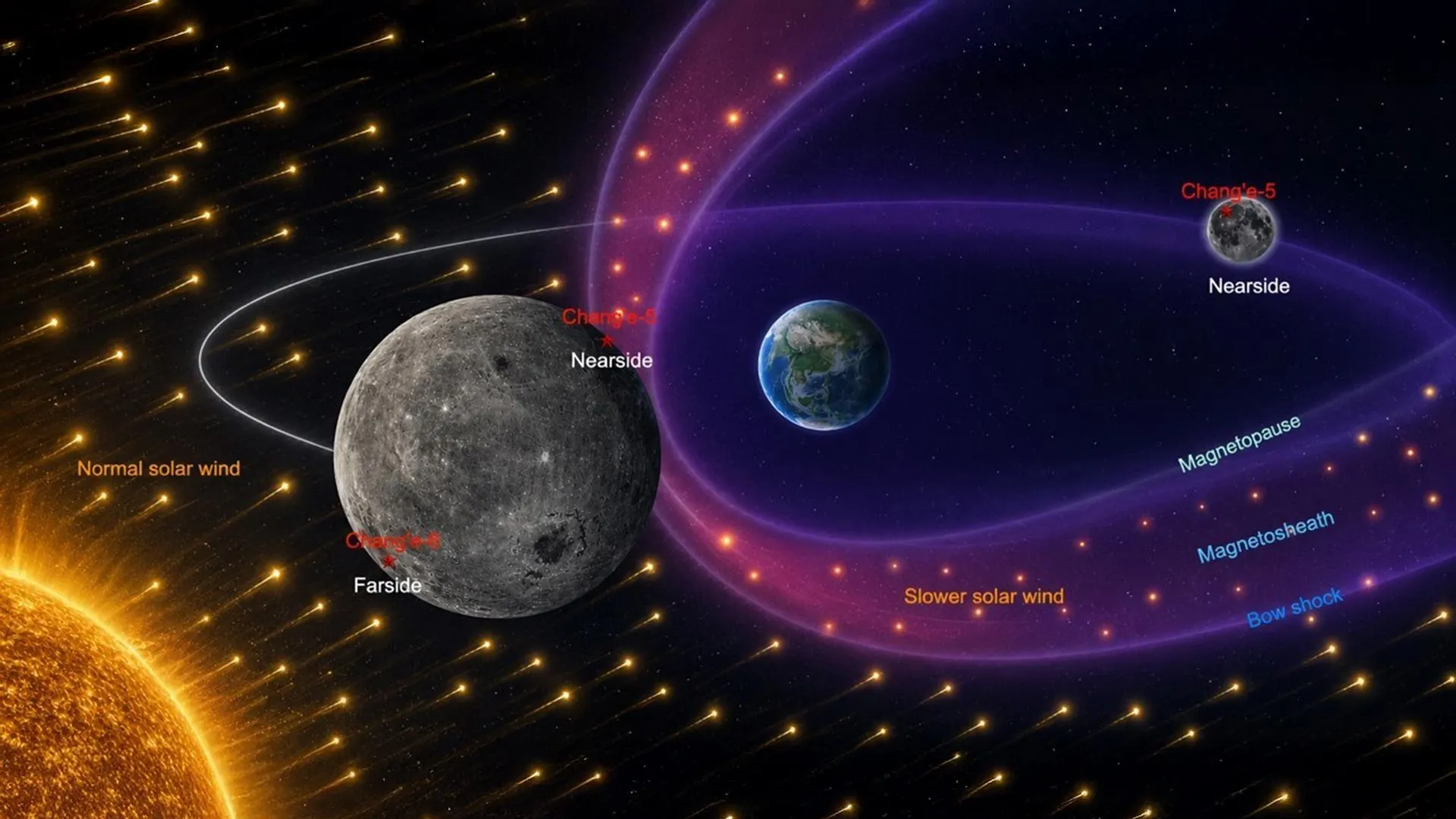
Scientists at the Chinese Academy of Sciences have found the first direct evidence that Earth's magnetic field controls how hard the solar wind hits the Moon, by comparing noble gases trapped in samples from both lunar hemispheres. The study, published in Nature Geoscience, analyzed 1.935 grams of far-side regolith returned by the Chang'e-6 mission in 2024 alongside earlier near-side material from Chang'e-5.
The team, led by postdoctoral researcher Xuhang Zhang, measured helium, neon, argon, krypton and xenon isotopes and found the far-side samples had a neon-20/neon-22 ratio of 11.34, notably lower than any near-side sample and consistent with more intense solar wind bombardment. Xenon released during heating experiments also showed particles penetrated far deeper into the far-side soil than the near side.
The researchers attribute the gap to Earth's magnetosheath, which slows the solar wind from about 400 km/s to roughly 200 km/s as the Moon passes through it — but only shields the near side, which always faces Earth. They estimate about 25% of solar wind exposure at the Chang'e-5 site came from this slowed, weaker flow, while the far side saw none of that protection. The team says lunar noble gases could now serve as a "fossil record" for reconstructing how Earth's magnetic field has changed over billions of years.