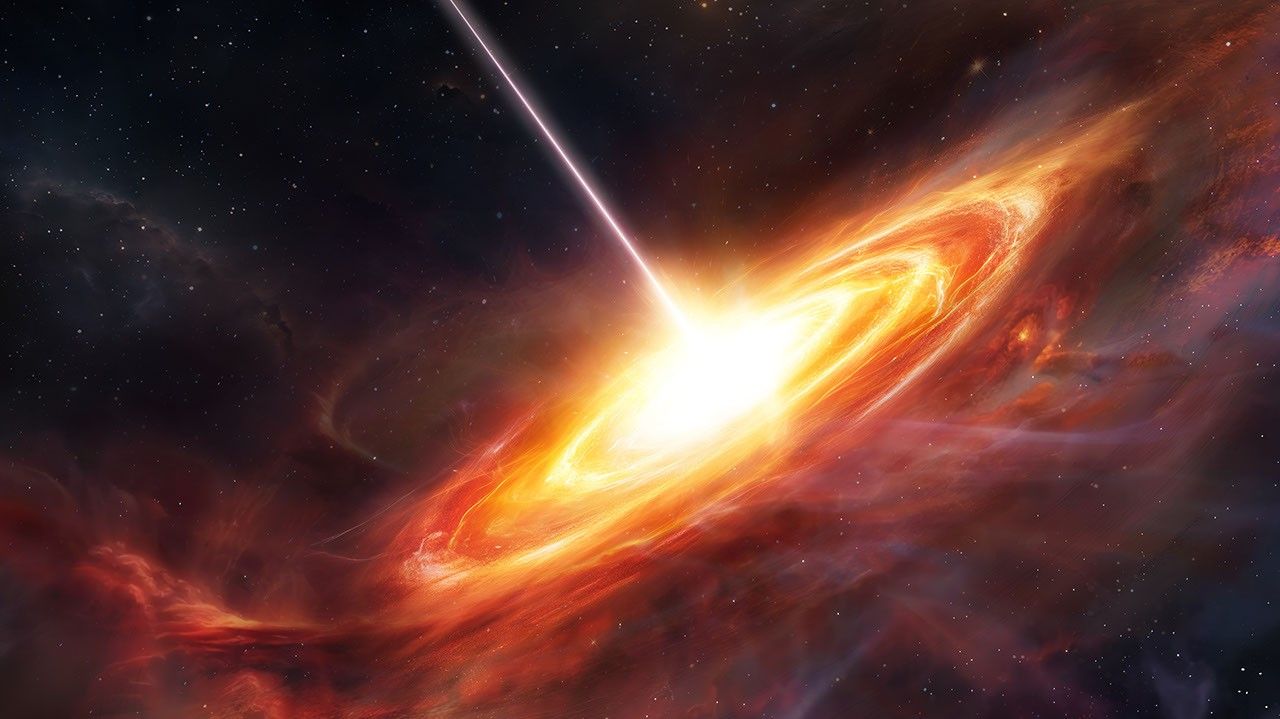
ESA's Euclid space telescope has identified 31 quasars from the early universe, including two that set a new distance record. The two oldest, sitting at redshifts of 7.77 and 7.69, shone when the cosmos was just 670 million years old — roughly 5% of its current age — and their light has traveled more than 13 billion years to reach us.
Quasars are powered by supermassive black holes devouring surrounding gas and dust, and the pair discovered by Euclid blazed with the brightness of a trillion Suns, edging past the previous record of redshift 7.64 set in 2021. Of the 31 new discoveries, 12 date to the universe's first 770 million years, more than doubling the number of known quasars from that remote era.
Led by Daming Yang of Leiden University with the wider Euclid Consortium — over 2,000 scientists across 300 institutes in Europe, the US, Canada and Japan — the findings, published in Astronomy & Astrophysics, tackle one of astrophysics' biggest puzzles: how such massive black holes grew so large so quickly. The data will also help astronomers study the epoch of reionization and inform NASA's upcoming Nancy Grace Roman Space Telescope mission.