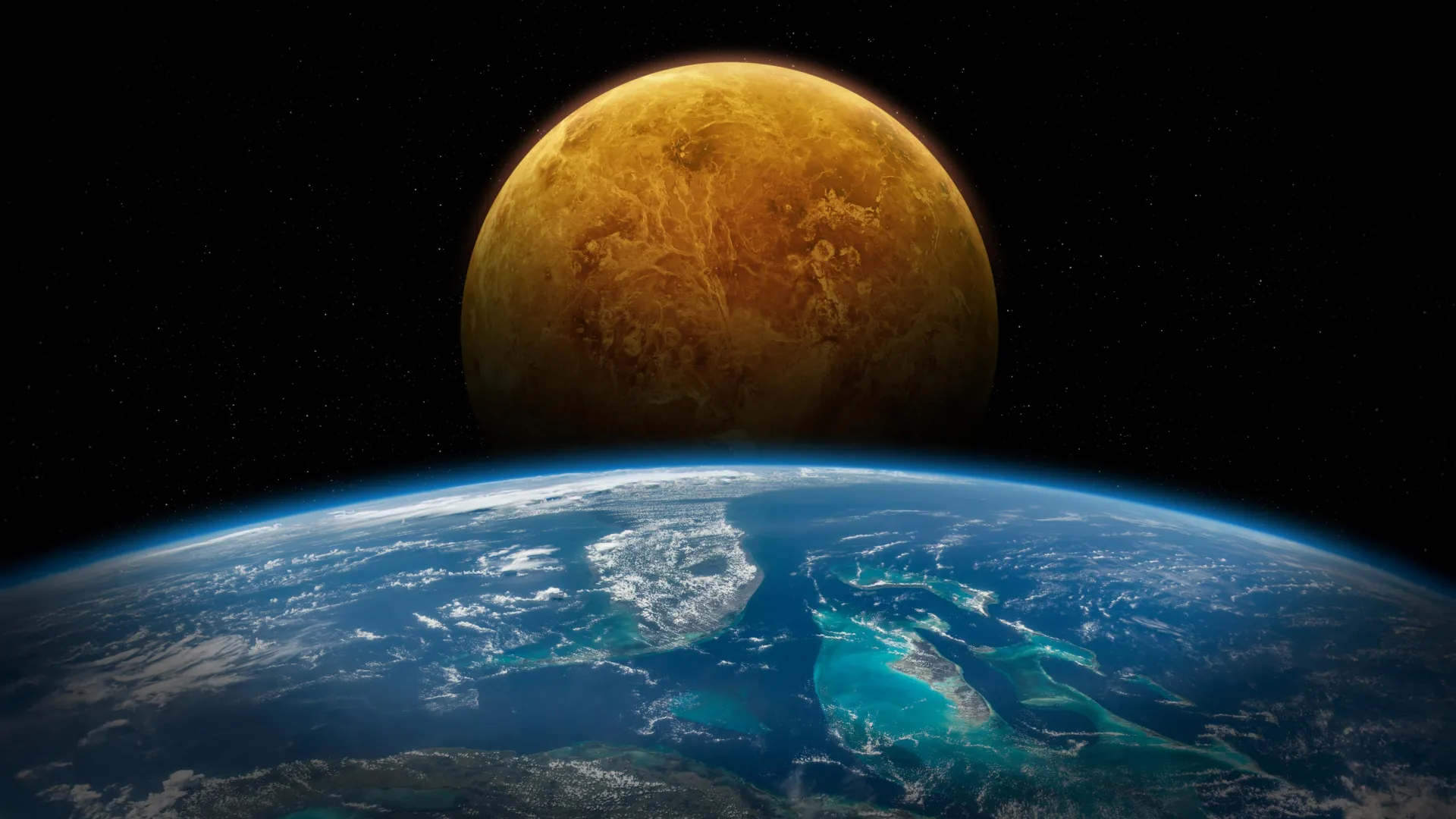
Researchers from Johns Hopkins University Applied Physics Laboratory (JHUAPL) and Sandia National Laboratories have calculated that asteroid impacts on Earth may have blasted hundreds of billions of microscopic organisms toward Venus over geological time. The study, which uses a framework called the "Venus Life Equation," estimates that roughly 100 viable microbial cells could be dispersing into Venus's cloud layers every year even today.
The key mechanism is panspermia via asteroid impact: when a large bolide strikes Earth, rock fragments can be ejected at escape velocity and eventually enter Venus's gravitational field. Hardy extremophile bacteria embedded in the debris could theoretically survive the journey. Once in Venus's upper clouds — where temperature and pressure resemble Earth's surface conditions — the microbes might find conditions marginally survivable, at least for brief periods each century. Over the past billion years alone, researchers estimate roughly 20 billion cells may have been transferred.
The findings carry a striking implication for astrobiology: if a future mission detects life in Venus's clouds, Earth itself could be the explanation. "If a future astrobiology mission discovers life in Venus's clouds, one possible explanation is that it originally came from Earth," the researchers stated. The study adds urgency to upcoming Venus missions, which must now account for the possibility that detected biosignatures might represent Earth contamination billions of years old.