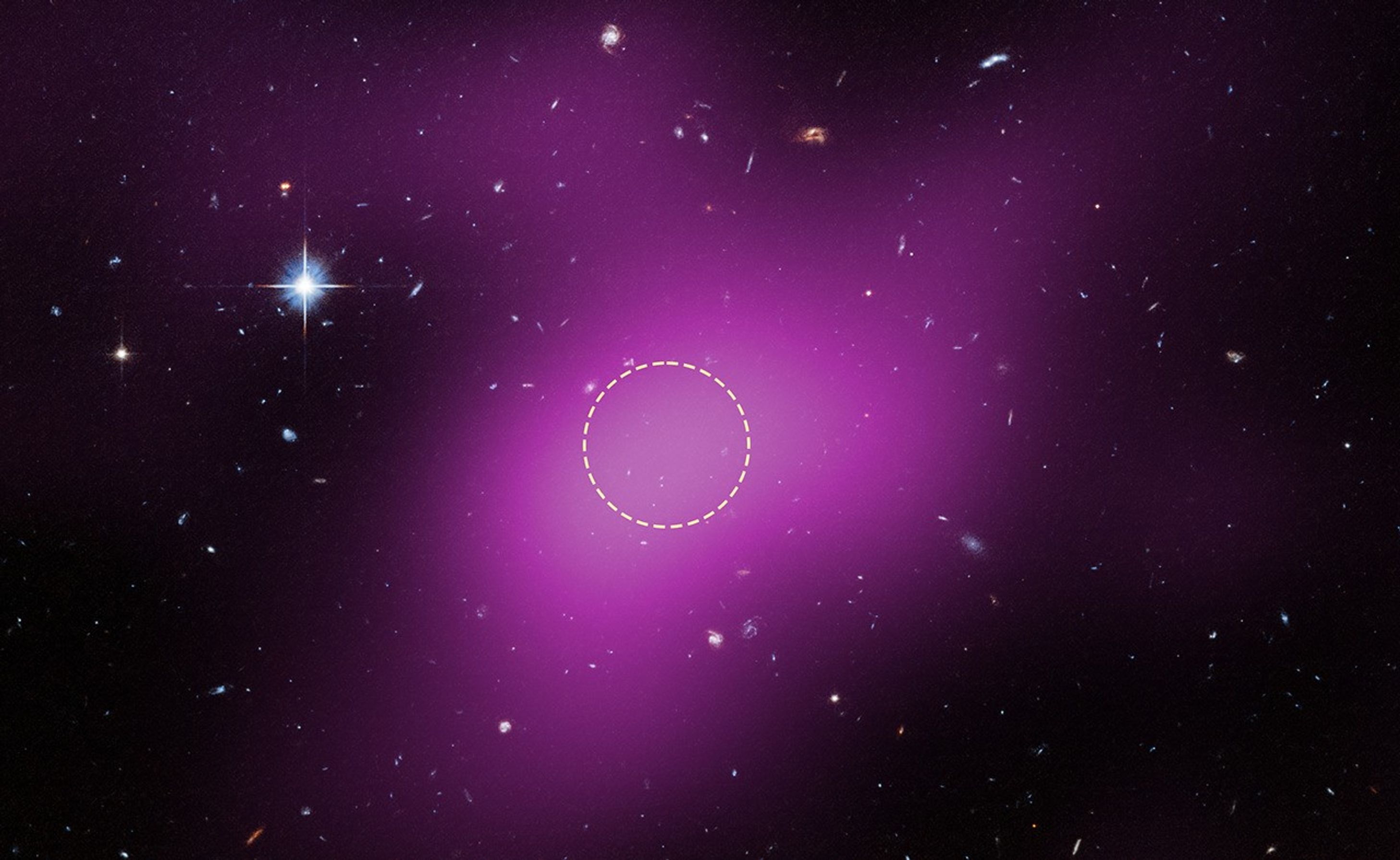
NASA's Hubble Space Telescope has identified a new type of cosmic object: a starless, gas-rich cloud dominated by dark matter. Dubbed "Cloud-9," it is the first confirmed detection of a "failed galaxy" that formed in the early Universe but never developed stars.
Cloud-9 sits about 14 million light-years away near spiral galaxy Messier 94. Its hydrogen core spans 4,900 light-years and contains gas roughly 1 million times the Sun's mass. To balance gravitational pressure, the cloud must contain approximately 5 billion solar masses of dark matter.
"This is a tale of a failed galaxy," said principal investigator Alejandro Benitez-Llambay of Milano-Bicocca University. "In science, we usually learn more from the failures than from the successes. In this case, seeing no stars is what proves the theory right."
Cloud-9 belongs to a class called RELHICs (Reionization-Limited H I Clouds) — hydrogen clouds from the early Universe that never progressed to star formation. Scientists predicted their existence for years, but Hubble's observations provided the first direct confirmation.
The object was initially detected three years ago by China's FAST radio telescope, then verified with the Green Bank Telescope and Very Large Array. "Cloud-9" was simply the ninth gas cloud catalogued near Messier 94's outer regions.