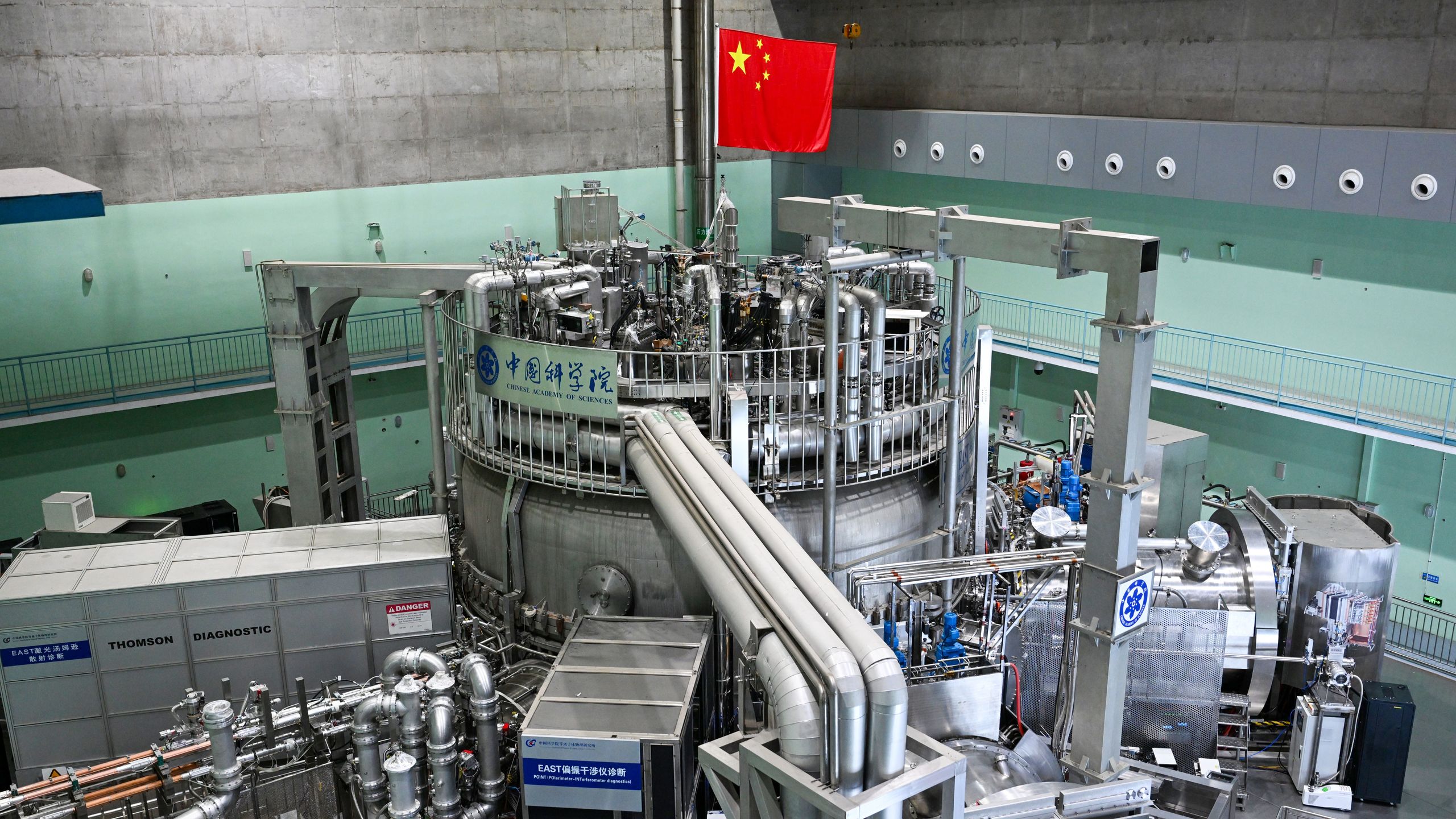
Scientists at China's Experimental Advanced Superconducting Tokamak (EAST) have achieved a major nuclear fusion breakthrough by reaching a "density-free regime" where plasma remains stable at densities 1.3 to 1.65 times beyond the Greenwald Limit—a barrier long considered unbreakable.
The Greenwald Limit has been a fundamental obstacle in fusion research because while higher plasma densities enable more atomic collisions (lowering energy costs for ignition), exceeding this limit typically causes plasma instability that kills the reaction. The EAST team overcame this by carefully managing initial fuel gas pressure and electron cyclotron resonance heating to control plasma-wall interactions.
This first experimental confirmation of the plasma-wall self organization (PWSO) theory has significant implications for next-generation tokamaks including ITER and commercial fusion projects, which may now operate at higher performance levels without disruption.