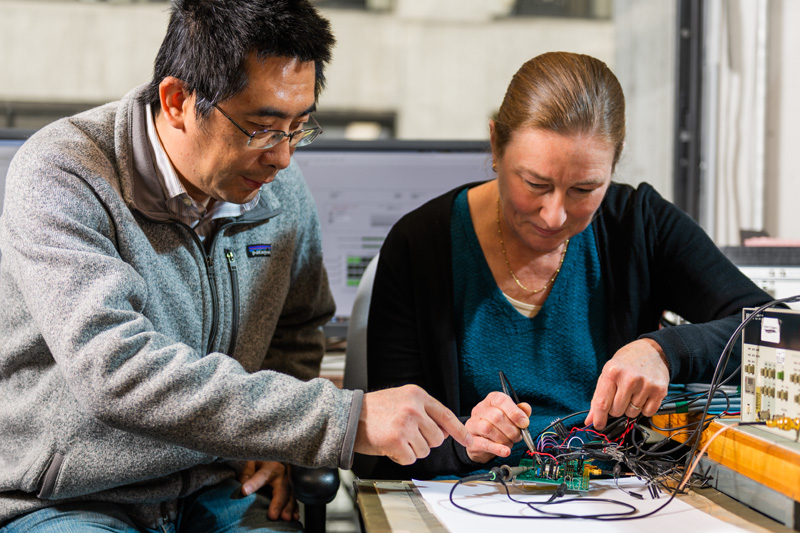
Researchers at Fermi National Accelerator Laboratory and MIT Lincoln Laboratory have successfully integrated ultra-low-power cryoelectronics directly inside ion-trap quantum systems, a breakthrough that could accelerate the path to scalable quantum computers. The team demonstrated that specialized chips operating at extreme cryogenic temperatures can reliably move individual ions, hold them at precise positions, and measure electronic noise — functions previously handled by bulky room-temperature equipment.
The collaboration, supported by two U.S. Department of Energy national quantum research centers — the Quantum Science Center and the Quantum Systems Accelerator — replaces conventional room-temperature controls with compact chips mounted inside the cryogenic environment. This hybrid approach dramatically reduces thermal noise and could ultimately support systems with tens of thousands of electrodes, a scale needed for practical quantum computing.