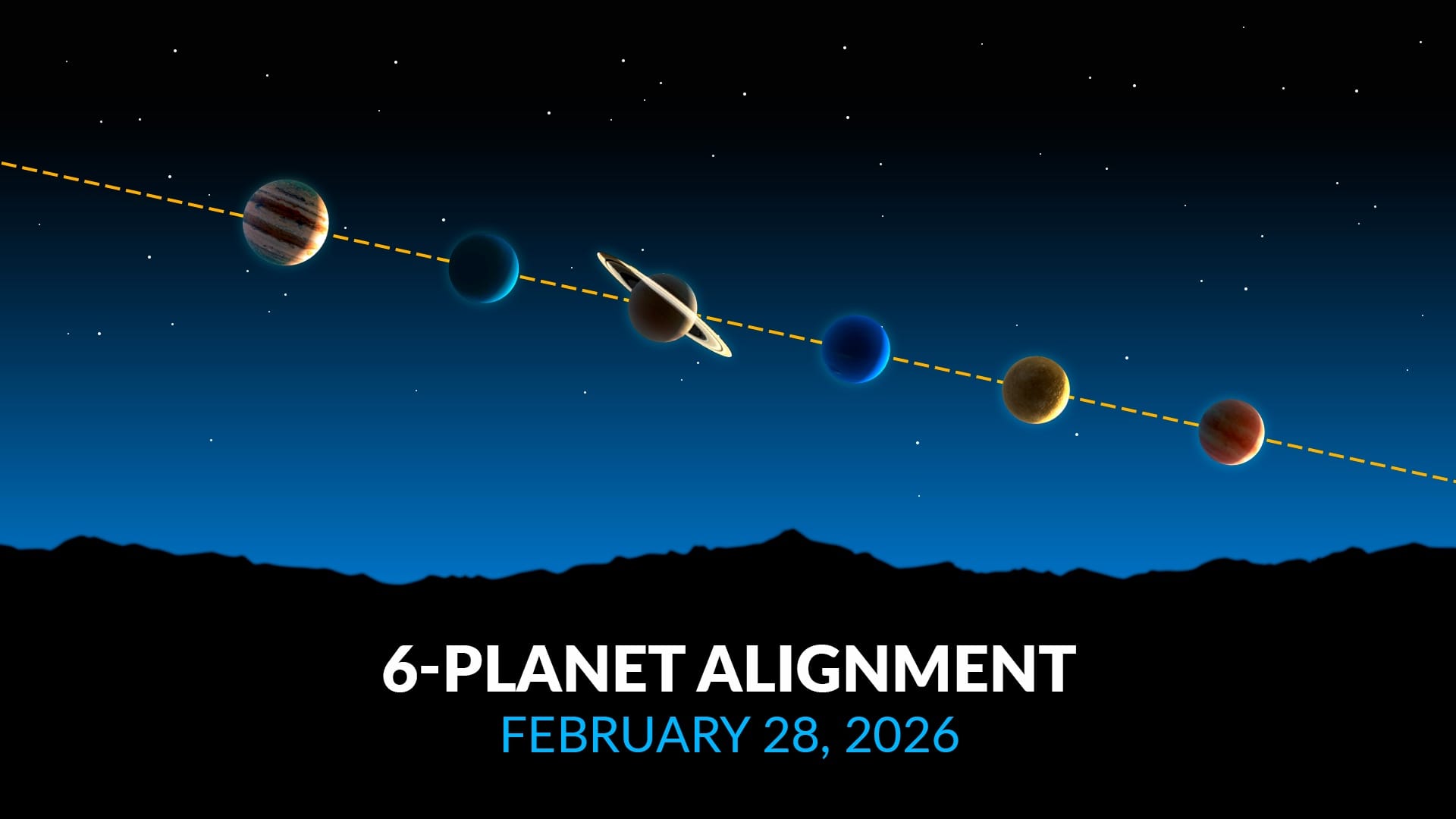
Mercury, Venus, Saturn, Jupiter, Uranus, and Neptune will line up along the ecliptic on the evening of February 28, giving stargazers a chance to spot six planets in a single sweep of the sky. Four of them — Mercury, Venus, Saturn, and Jupiter — are bright enough to see without any equipment, while Uranus and Neptune require binoculars or a small telescope.
The best window opens 30 to 60 minutes after local sunset. Look low on the western horizon for Mercury, Venus, and Saturn clustered together, then turn southeast to find Jupiter shining near a bright Moon. Uranus sits higher in the southwest between the two groups. A clear, unobstructed western horizon is essential since Mercury sets quickly after the Sun.
Astronomers note that while multi-planet alignments happen periodically, having six visible in the same evening is uncommon. The next comparable evening parade is not expected until 2028. Experts recommend using a sky-tracking app to help locate the dimmer targets.