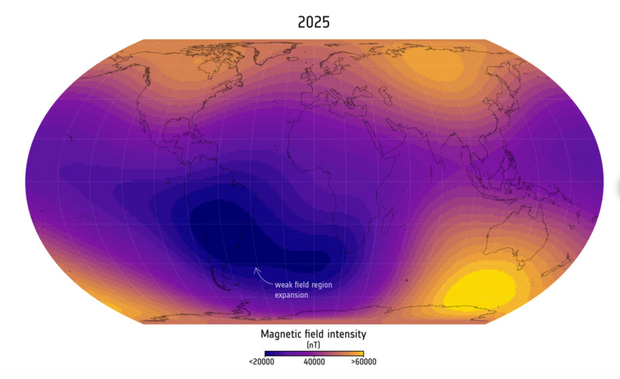
The South Atlantic Anomaly — a vast weak spot in Earth's magnetic field stretching from South America toward Africa — has expanded by roughly two million square miles since 2014, an area nearly half the size of continental Europe. New analysis of 11 years of data from ESA's Swarm satellites reveals the weakening has accelerated since 2020, with different sections deteriorating at varying rates.
Researchers found that unusual "reverse flux patches" deep beneath the anomaly are redirecting magnetic field lines back into Earth's core instead of emerging outward, driving the expansion. "It's changing differently towards Africa than it is near South America. There's something special happening in this region," said lead researcher Chris Finlay of the Technical University of Denmark. Meanwhile, the strong magnetic region over Canada has shrunk by an area the size of India, while Siberia's magnetic region expanded by an area comparable to Greenland.
The anomaly poses a growing challenge for space infrastructure: satellites passing through the region face higher radiation doses, risking malfunctions and hardware damage. Swarm Mission Manager Anja Stromme confirmed the satellites remain healthy and could extend observations beyond 2030 to capture the next solar minimum.