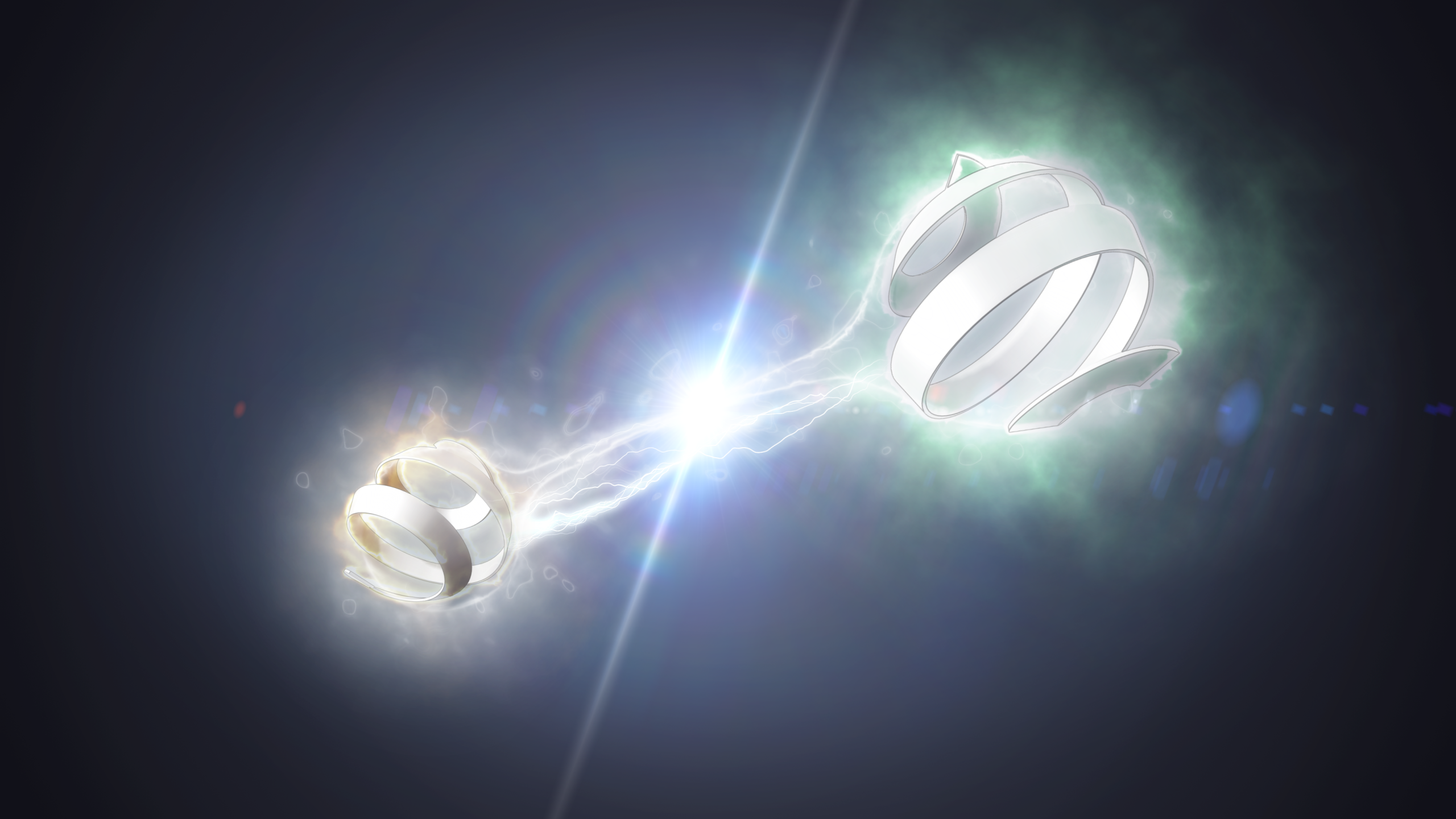
Physicists at CERN's Large Hadron Collider have found strong evidence that pairs of Z bosons become quantum entangled when produced by a decaying Higgs boson. Both the ATLAS and CMS experiments independently reached the same conclusion using data from the LHC's second and third operational runs.
Z bosons, which carry the weak nuclear force, are unstable and vanish almost instantly, so researchers tracked them indirectly through their decay into pairs of electrons or muons. Because a Higgs boson has zero spin, the two Z bosons it produces must have spin states that sum to zero, a constraint that let scientists test for entanglement between particles far heavier and shorter-lived than any studied this way before.
The most sensitive test found the entangled state favored over the non-entangled alternative at 4.7 sigma, just short of the 5-sigma threshold physicists require to call something a confirmed discovery. The result builds on earlier entanglement evidence in top quarks and shows the Higgs boson can serve as a tool for probing quantum effects at extreme energies, with more data expected from the upcoming High-Luminosity LHC upgrade.