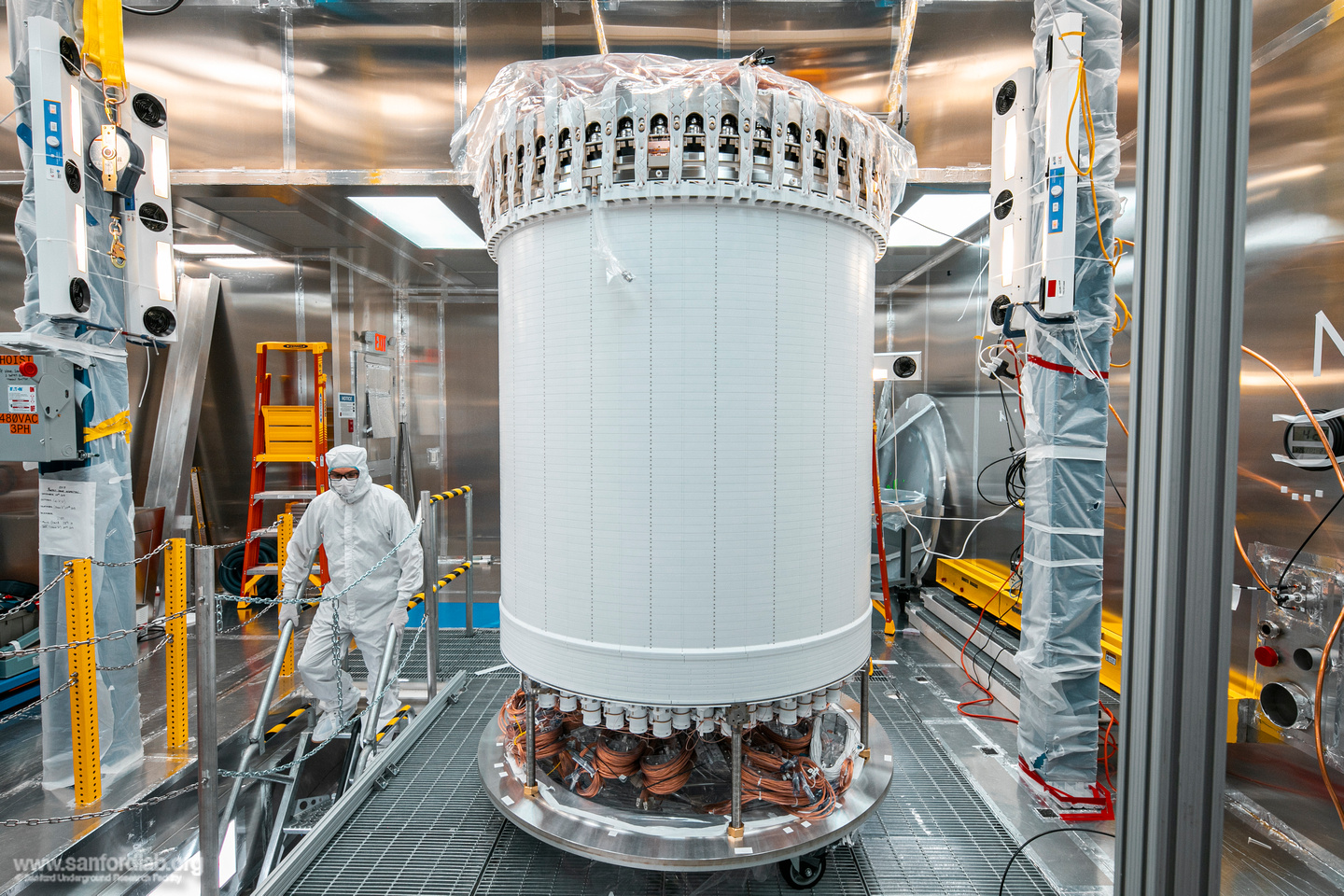
The LUX-ZEPLIN (LZ) experiment, buried nearly a mile underground at South Dakota's Sanford Underground Research Facility, has recorded a single particle interaction that an international team of 250 scientists is struggling to explain as ordinary background noise. The signal appeared in exactly the energy range where dark matter — the invisible substance making up roughly 85% of the universe's mass — is expected to show up.
Analyzing 220 days of data collected between March 2023 and April 2024 with 10 tonnes of ultrapure liquid xenon, the LZ team calculated just a 0.5% chance the event stems from a known background source, a statistical significance of 2.6 sigma. That falls well short of the 5-sigma threshold physicists require to claim a discovery, but it is the most compelling hint of a weakly interacting massive particle (WIMP) the experiment has produced.
"We're very intrigued to see this event in the data, in the region where we expect dark matter to show up and the competing backgrounds are very low," said Rick Gaitskell of Brown University, the LZ experiment's spokesperson. If confirmed, the particle would weigh at least 200 GeV/c² — more than 200 times the mass of a proton. LZ continues collecting data to determine whether the signal strengthens or fades.