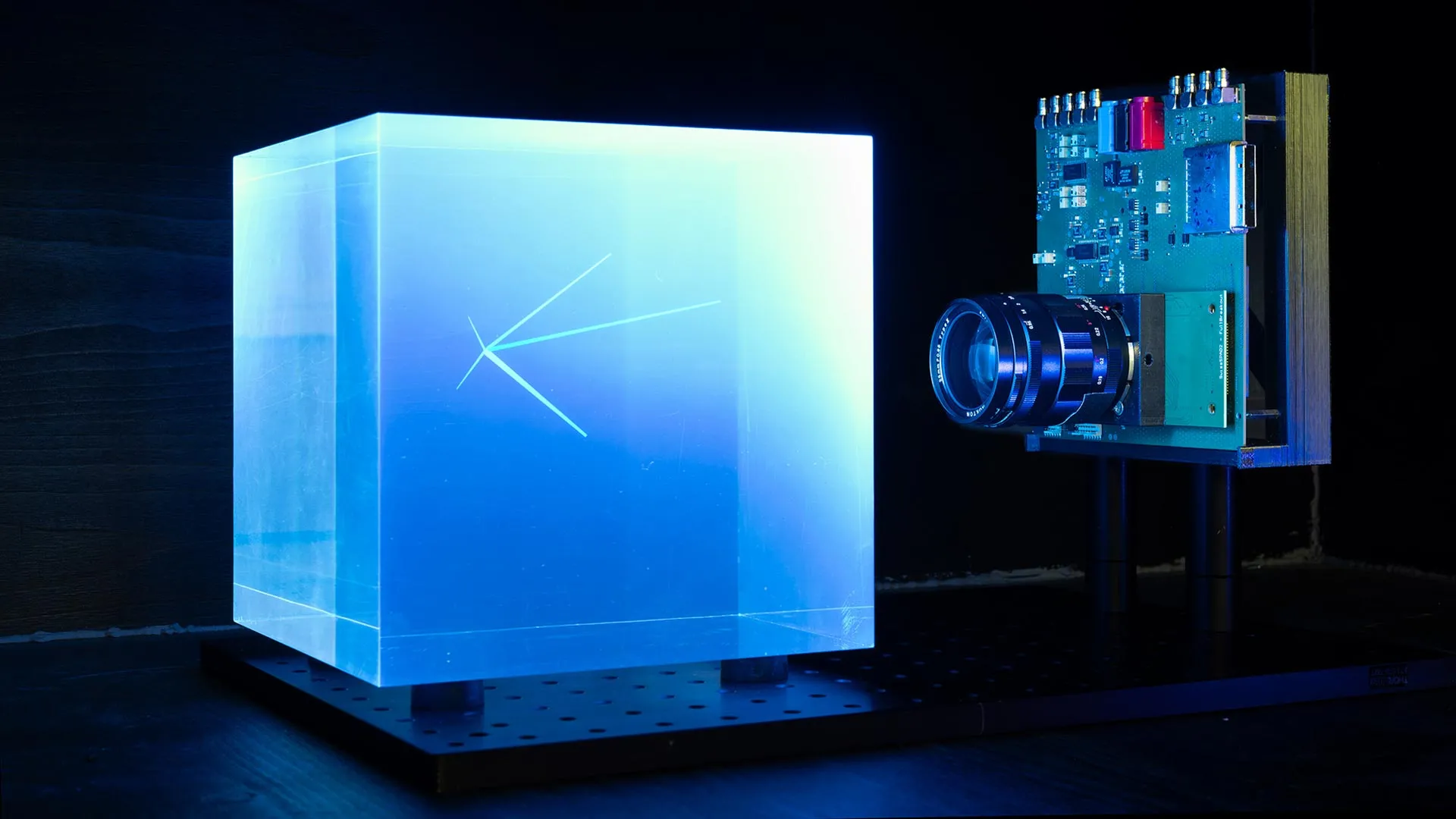
Researchers at ETH Zurich and EPFL have unveiled PLATON, a new type of particle detector that reconstructs the 3D paths of neutrinos and other weakly interacting particles using a single block of light-producing material instead of millions of tiny wired components.
The device, described by PhD student Till Dieminger, Dr. Saul Alonso-Monsalve, Professor Davide Sgalaberna and Professor Edoardo Charbon, combines a light-field (plenoptic) camera with single-photon avalanche diode sensors and a transformer-based neural network. The camera captures both the intensity and direction of scintillation light produced when a particle passes through the block, letting AI software reconstruct its track even from as few as five detected photons. In prototype tests on a 10x10x10 cm block, PLATON achieved sub-millimeter spatial resolution; simulations suggest a full cubic-meter version could still resolve tracks to a few millimeters.
Legacy detectors like Japan's T2K experiment need roughly 2 million individual scintillator cubes wired with electronics to achieve similar 3D tracking. Replacing that wall of hardware with one monolithic block and a camera could make future neutrino and dark-matter experiments cheaper to build and easier to scale up. The work, funded by the Swiss National Science Foundation, was published July 17 in Nature Communications.