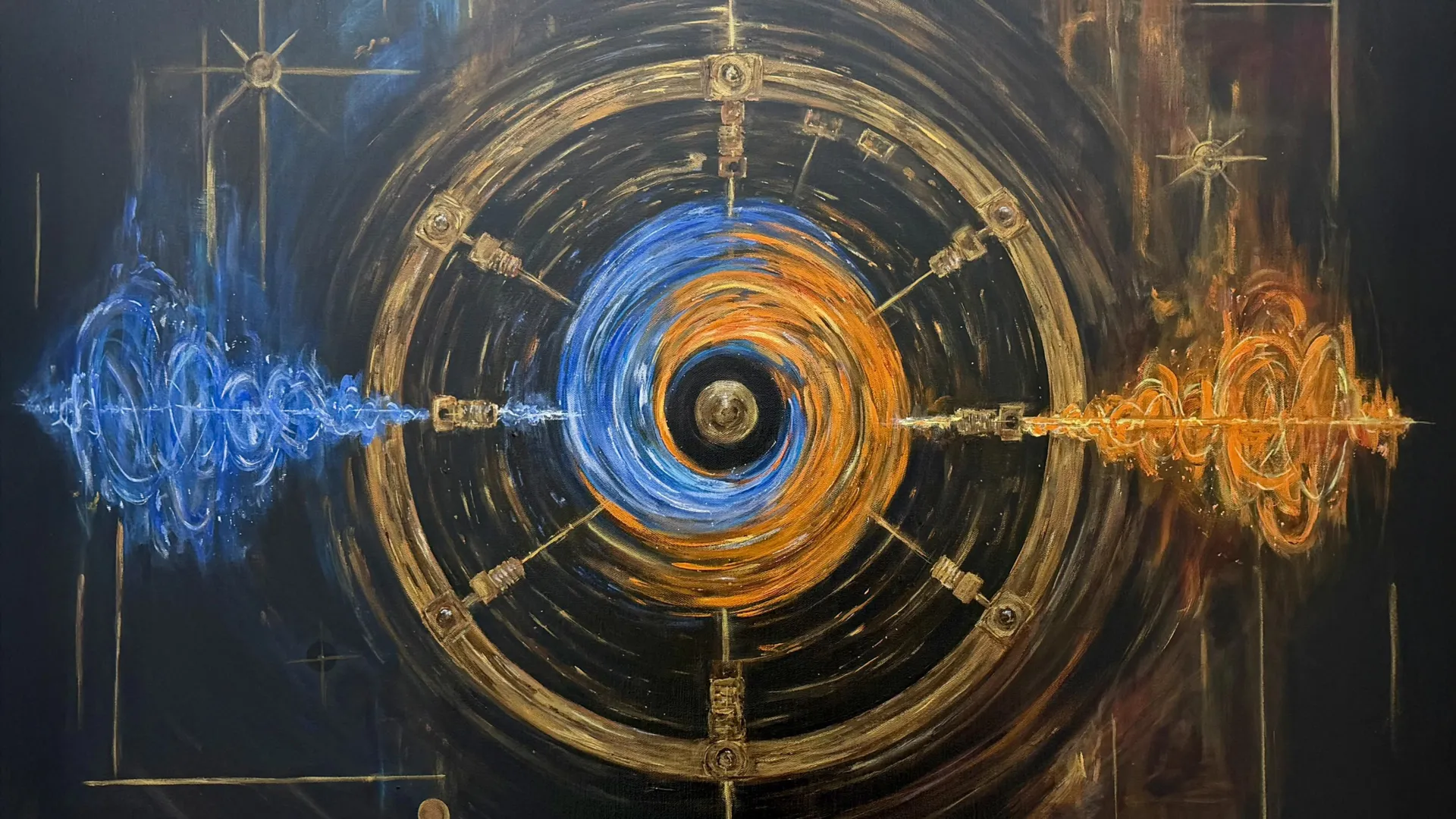
Physicists at the CUNY Graduate Center's Advanced Science Research Center have recreated the energy-extraction physics of a spinning black hole using a stationary lab device, according to a study published in Nature on July 11, 2026. Led by Andrea Alù with postdoctoral researcher Hadiseh Nasari and former PhD student Hady Moussa, the team built a ring of electronic resonators whose properties were rapidly and synchronously adjusted, generating a traveling pattern that made electromagnetic waves behave as if encountering an object spinning at extreme speed — without any physical movement.
The experiment reproduces the Penrose-Zel'dovich process, a mechanism physicist Roger Penrose proposed more than 50 years ago for extracting energy from a black hole's ergosphere. Waves with the right rotational properties were amplified, pulling energy out of the synthetic rotation just as theory predicted for particles near a real black hole.
"Our approach facilitates a new method of wave-matter interaction in which waves with selected rotational properties extract energy from synthetic time-engineered rotation," Alù said. The team says the platform could open new directions in optics, wireless communications and quantum technologies.