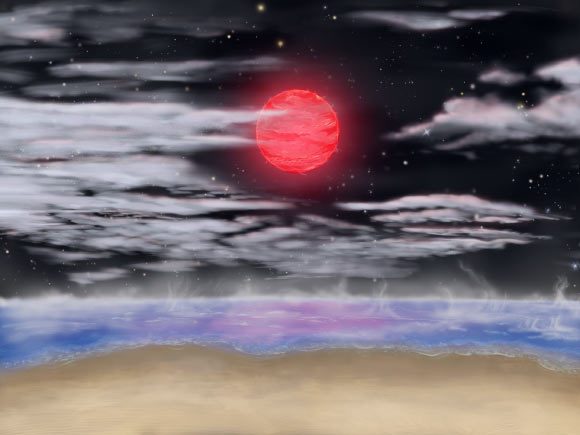
Astronomers have identified Gliese 3378b, a rocky exoplanet roughly twice Earth's size orbiting within the habitable zone of its parent star, Gliese 3378, just 25 light-years away in the constellation Camelopardalis. The planet has a mass about 2.3 times that of Earth and completes an orbit every 21.45 days, receiving around 90% of the radiation Earth gets from the Sun.
The discovery, led by Dr. Michael Endl of the University of Texas at Austin and Dr. Paul Robertson of UC Irvine, relied on data from the Habitable-zone Planet Finder at the Hobby-Eberly Telescope in Texas and the NEID Spectrometer at Kitt Peak National Observatory in Arizona. The findings were published in The Astrophysical Journal.
Gliese 3378b sits right at the edge of the so-called cosmic shoreline, the boundary where a star's radiation is strong enough to strip away a planet's atmosphere, so it remains unclear whether the planet has retained one. That uncertainty makes it a high-priority target for follow-up observations aimed at determining whether it could actually support life.