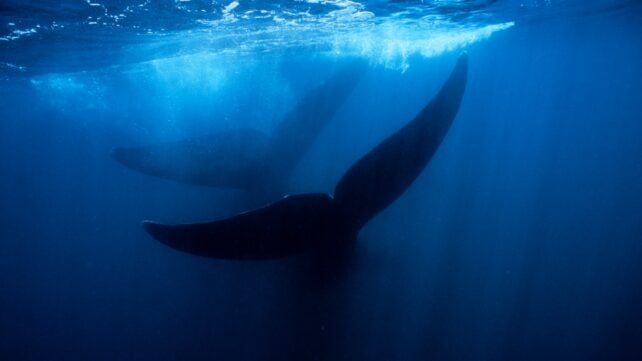
Chinese scientists using the deep-sea submersible Fendouzhe have discovered the world's largest whale graveyard in the Diamantina Fracture Zone, a remote rift valley stretching 1,200 kilometers between Australia and Antarctica. The team from the Chinese Academy of Sciences documented 485 whale-fall sites at depths reaching 7,002 meters — the deepest and most extensive cetacean bone bed ever found. The oldest specimen dates back 5.26 million years, making this a rare "living fossil record" still accumulating new remains today.
The study, published in Nature, identified both modern and extinct beaked whale species, including at least one previously unknown species. Lead researcher Xiaotong Peng described the find as "completely unexpected," saying the scale was "far beyond anything we had imagined." Each whale-fall site supports its own thriving ecosystem: chemosynthetic bacteria, bone-eating Osedax worms, and microbial mats convert the ancient carcasses into energy for deep-sea creatures that never see sunlight.
Scientists classify the Diamantina graveyard as a rare "Wachsend-Lagerstätte" — an exceptional fossil bed that is still actively growing. The discovery reshapes understanding of whale evolution and migration patterns over millions of years, and may explain how deep-sea ecosystems along this corridor have persisted across geological epochs.