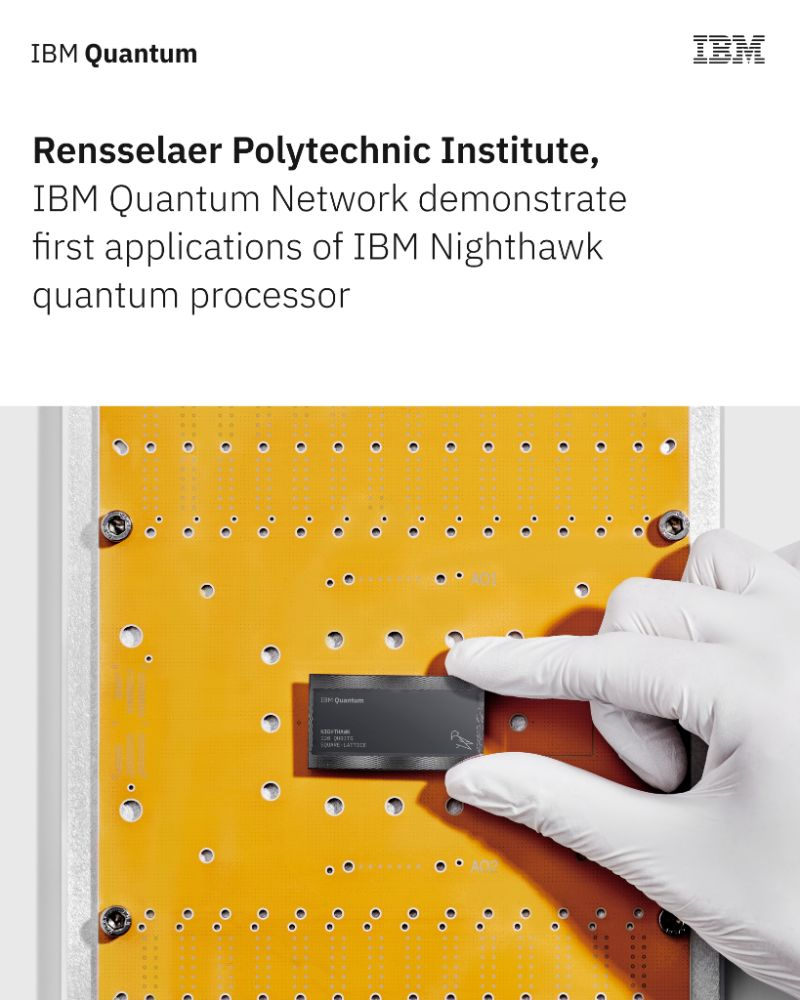
Two independent research teams have validated IBM's Nighthawk quantum processor in real-world applications spanning particle physics simulation and cybersecurity optimization. The studies, published June 20, mark a significant milestone in demonstrating practical quantum advantage on a production-grade 120-qubit system.
In the first study, scientists from Rensselaer Polytechnic Institute, Stony Brook University, the University of Washington, and Brookhaven National Laboratory simulated nucleon-antinucleon interactions using a two-dimensional quantum chromodynamics model, employing structured error cancellation techniques to overcome hardware noise. In the second study, researchers from Rensselaer and Marist University built an automated pipeline that converts network security data into graph optimization problems, enabling Nighthawk to identify malicious denial-of-service attacks while protecting legitimate traffic.
The processor's grid-based architecture outperformed competing heavy-hex layouts in routing efficiency, requiring fewer two-qubit operations — a key metric for reducing error accumulation in quantum circuits. The results support IBM's roadmap toward fault-tolerant quantum computing by 2029 and demonstrate that the Nighthawk architecture excels at complex, multi-qubit real-world workloads.