Overview
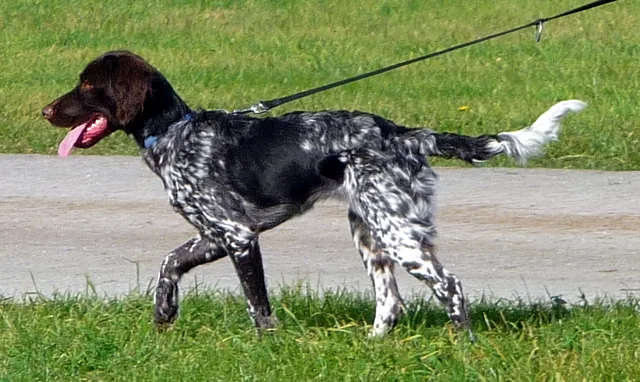
The Blue Picardy Spaniel is a French pointing spaniel with a speckled grey-black coat that gives a bluish shade. It is quiet indoors, gentle with people and has plenty of stamina in the field.
It is found mostly in France and Canada and is recognised by the FCI, the Canadian Kennel Club and the United Kennel Club.
History
Around 1900 the Somme estuary was a famous wildfowling area. British shooters boarded their dogs there because of quarantine rules at home, and English Setter blood entered the local Picardy Spaniels. This gave rise to the blue-coated variety.
A Picardy Spaniel club was formed in 1907, and in 1938 France recognised the Blue Picardy as a separate breed. It reached Canada in the late 1980s and was recognised there in 1995.
Appearance
A medium to large spaniel, about 56 to 61 cm tall and around 20 to 25 kg. The coat is flat or slightly wavy with feathering on the ears, legs, belly and tail, and shows grey-black speckling with black patches.
It has a long, broad muzzle, silky ears reaching about the nose tip, a deep chest and strong muscular limbs.
Temperament
Gentle, responsive and eager to please, the Blue Picardy thrives on company and is especially good with children. It is calm and not given to much barking.
Its quiet manner hides high stamina, so it does best with people who enjoy long outings and play.
Care and exercise
Give it plenty of daily exercise, ideally with space to run and tasks such as retrieving or scent work. It is happiest living in the house with its family rather than in a kennel.
Brush the feathered coat a few times a week and check the ears regularly for dirt and moisture.