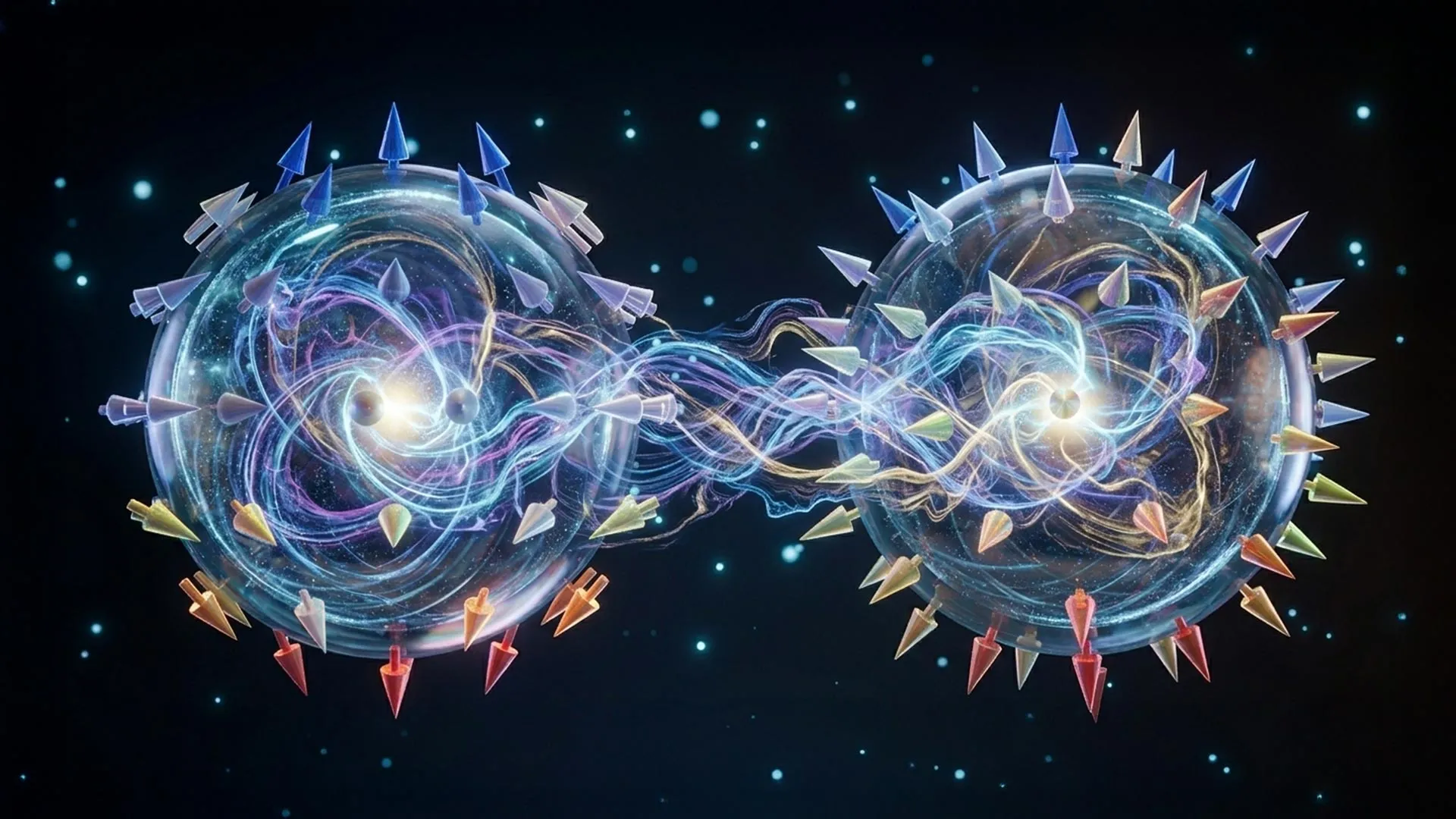
Researchers at the University of the Witwatersrand and Huzhou University have uncovered a hidden 48-dimensional topological structure inside entangled photons, using nothing more than standard quantum optics equipment. The discovery, published in Nature Communications, reveals over 17,000 distinct topological signatures encoded in the orbital angular momentum of entangled light.
The team found that spontaneous parametric downconversion — one of the most common techniques for generating entangled photons — naturally creates these complex structures. "The topology was always there, it just had to be found," said lead author Robert de Mello Koch. Remarkably, only a single property of light is needed to produce topology, overturning the assumption that at least two properties were required.
The findings open a vast new "alphabet" for encoding quantum information that could make quantum systems more resistant to noise and errors. Beyond two dimensions, the topological structures become so complex they cannot be described by a single number, suggesting untapped potential for quantum computing and secure communications.