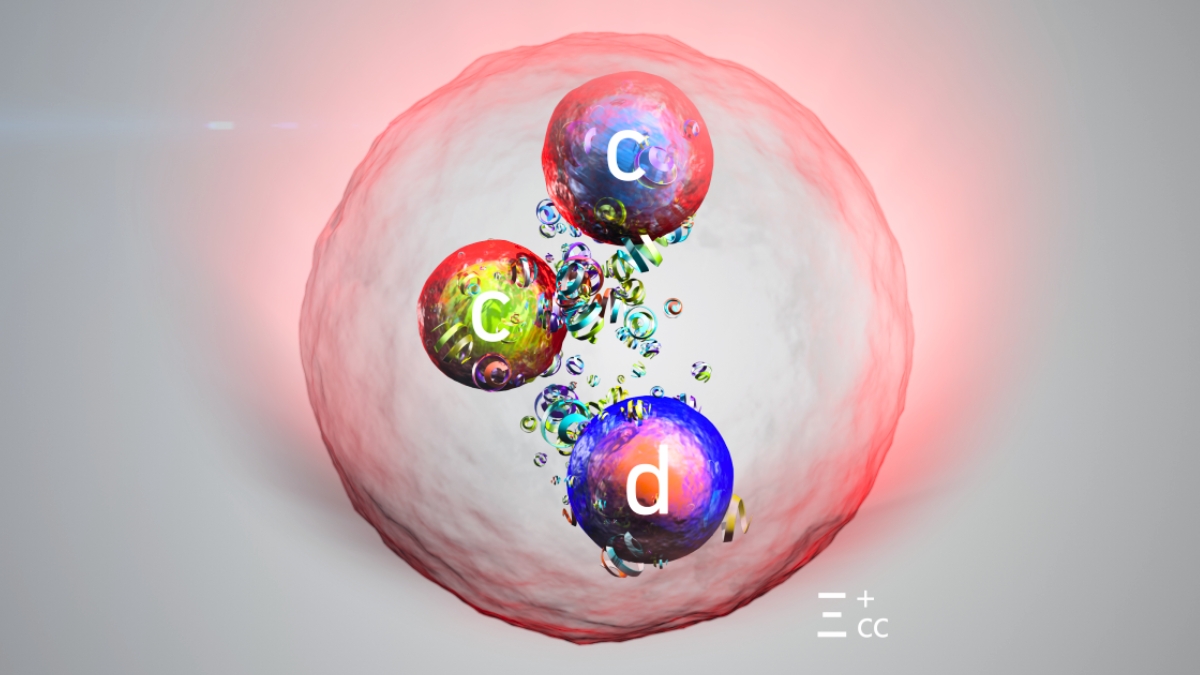
The LHCb experiment at CERN's Large Hadron Collider has discovered a new subatomic particle — the Ξcc⁺ (Xi-cc-plus) — composed of two charm quarks and one down quark. The particle is structurally similar to a proton but approximately four times heavier, with the proton's two up quarks replaced by heavier charm quarks. The discovery was achieved with a statistical significance of 7 sigma, well above the 5-sigma threshold required to claim a discovery.
This is only the second baryon with two heavy quarks ever observed, and the first new particle found using the upgraded LHCb detector since its 2023 overhaul. The finding, announced at the Moriond particle physics conference in Italy on March 17, brings the total number of hadrons discovered by LHC experiments to 80.
The discovery will help physicists test quantum chromodynamics models and better understand how the strong nuclear force binds quarks into composite particles. "This major result exemplifies how LHCb's unique capabilities play a vital role in LHC success," said CERN Director-General Mark Thomson.