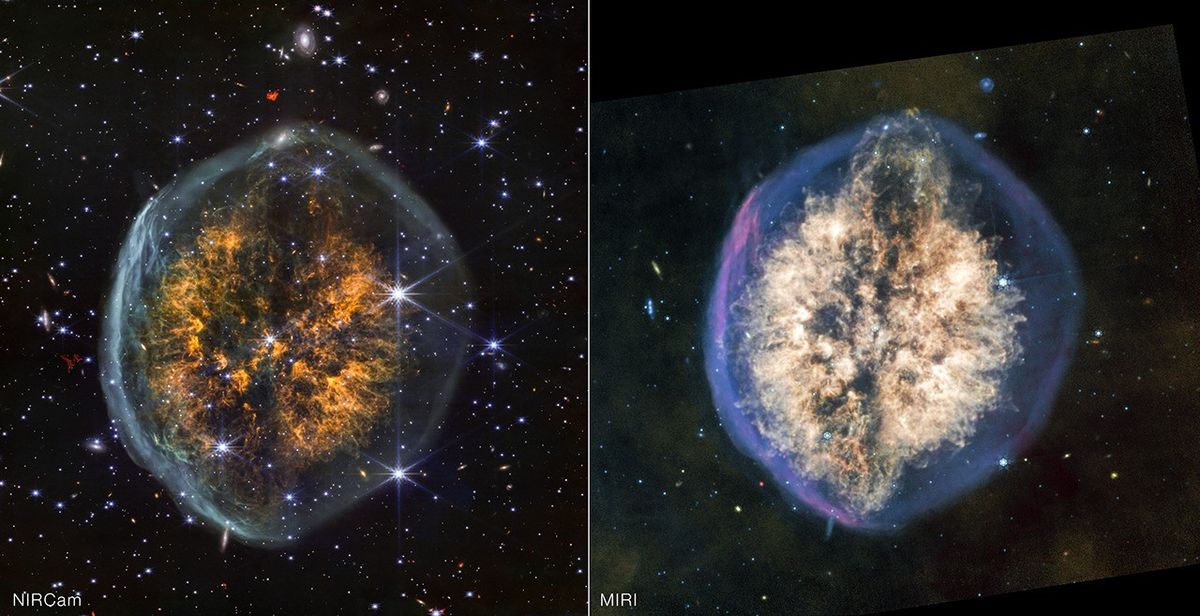
NASA's James Webb Space Telescope has captured stunning new images of PMR 1, a nebula about 5,000 light-years away in the constellation Vela that bears an uncanny resemblance to a human brain inside a transparent skull — earning it the nickname "Exposed Cranium." Webb's NIRCam and MIRI instruments reveal layered gas structures and a distinctive dark lane running vertically through the center, creating the appearance of left and right brain hemispheres.
The nebula surrounds a dying star whose ultimate fate remains unknown. If massive enough, it will explode as a supernova; if Sun-like, it will shrink into a dense white dwarf. Webb's observations show two distinct evolutionary phases: an outer hydrogen-rich shell expelled first, and a structured inner cloud containing a mix of different gases. The dark dividing lane appears to be caused by twin jets bursting from the central star in opposite directions.
The nebula was first glimpsed in infrared light over a decade ago by NASA's now-retired Spitzer Space Telescope, but Webb's far superior resolution has transformed our understanding of its complex structure.