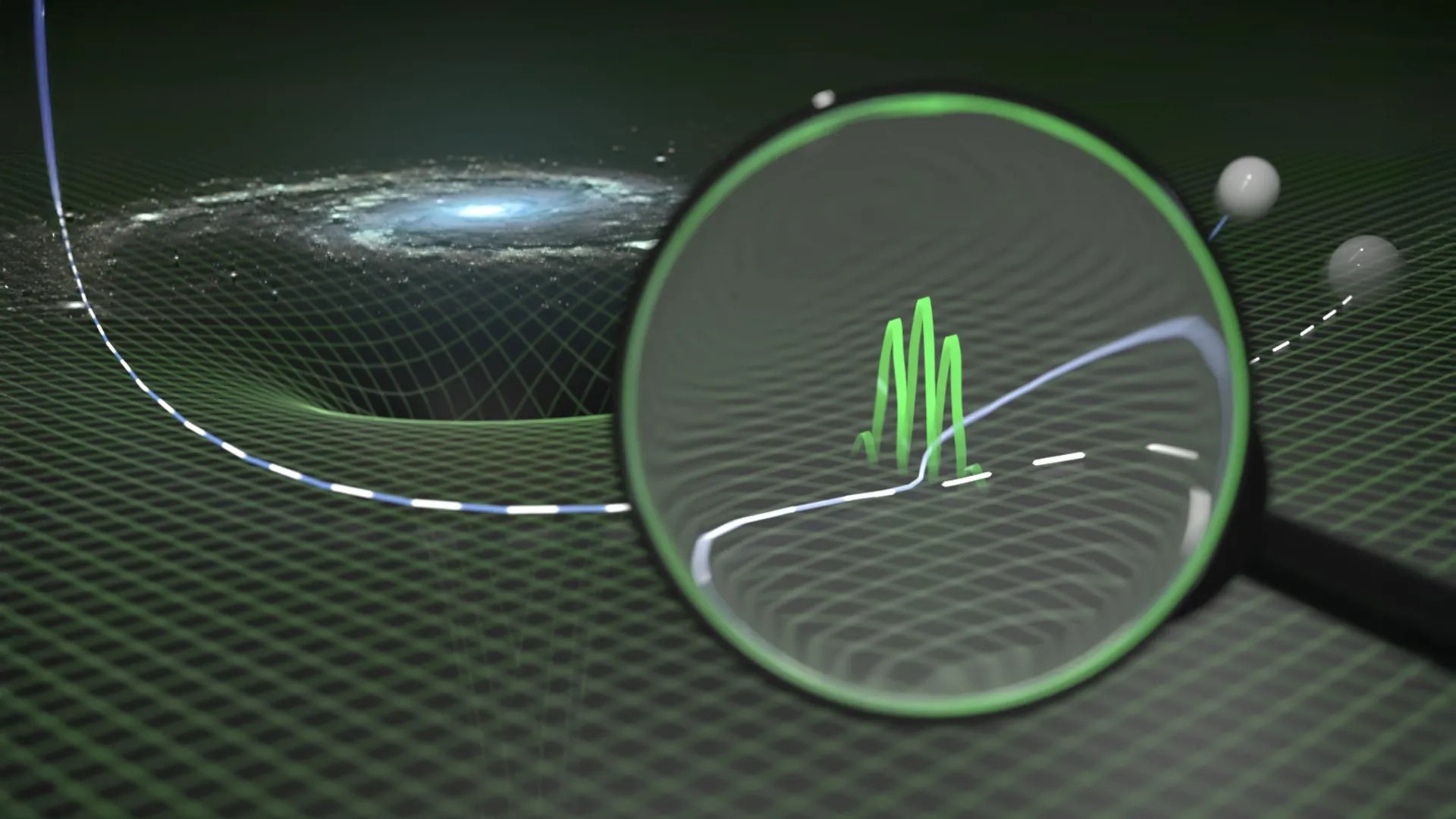
Researchers at TU Wien have developed the "q-desic equation" — a quantum version of geodesics — demonstrating that in quantum spacetime, particles may deviate from the shortest path between two points predicted by Einstein's general relativity. The work, published in Physical Review D, was led by physicist Benjamin Koch alongside PhD student Ali Riahinia and Angel Rincón from the Czech Republic.
The team successfully quantized the metric for a spherically symmetric, time-independent gravitational field. Their equation reveals that deviations from classical paths become substantial at cosmological scales around 10²¹ meters, while remaining negligible for ordinary systems like Earth's orbit.
The findings could help solve longstanding cosmic puzzles, including the unexplained rotation speeds of spiral galaxies and the nature of dark energy. Crucially, the q-desic equation provides measurable criteria for distinguishing between competing quantum gravity theories — a step toward finally bridging quantum mechanics and general relativity.