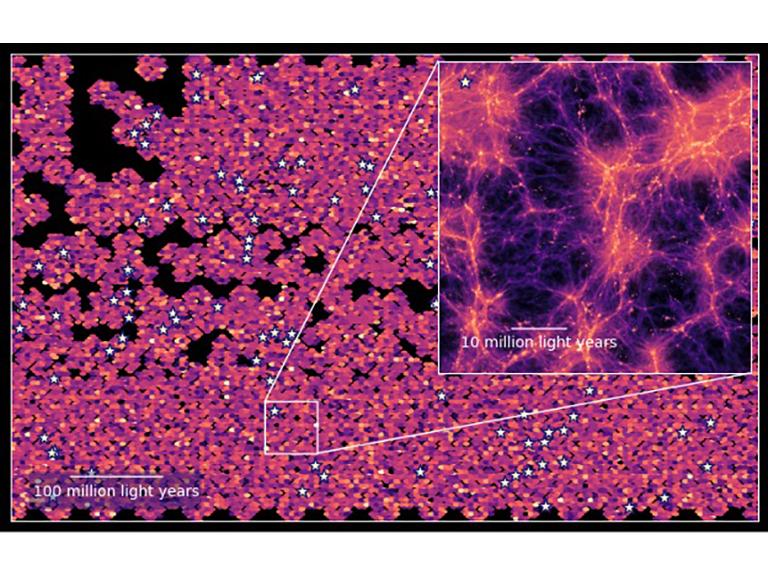
An international team led by Maja Lujan Niemeyer at the Max Planck Institute for Astrophysics has built the largest and most detailed 3D map of Lyman-alpha radiation from the early universe. Using data from the Hobby-Eberly Telescope Dark Energy Experiment (HETDEX) at McDonald Observatory in Texas, the researchers charted over 1 million bright galaxies and processed more than 600 million spectra across a sky area equivalent to 2,000 full moons.
The map captures faint ultraviolet light emitted by energized hydrogen atoms 9 to 11 billion years ago during "cosmic noon" — the peak era of star formation. Rather than identifying individual galaxies, the team used a technique called line intensity mapping to reveal the entire "sea of light" permeating intergalactic space, including hidden cosmic structures invisible to traditional observation methods.
HETDEX principal investigator Karl Gebhardt of UT Austin noted that only about 5% of the experiment's roughly half-petabyte dataset has been used for its primary dark energy goals, leaving vast scientific potential still untapped. The findings were published in The Astrophysical Journal on March 3, 2026.