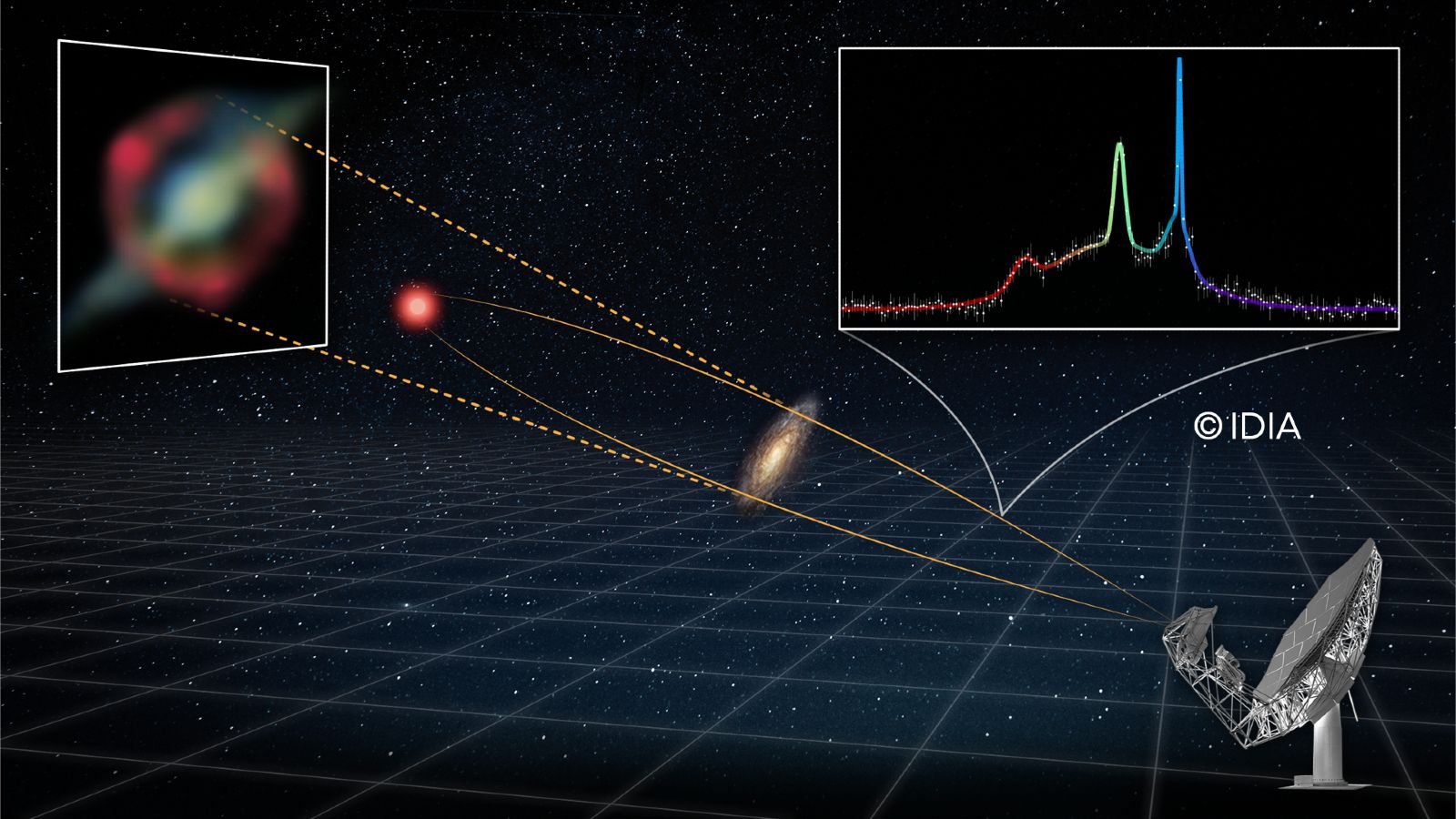
South African radio telescope MeerKAT has detected the most distant and brightest natural mega-laser ever observed — a hydroxyl gigamaser designated HATLAS J142935.3–002836, located over 8 billion light-years from Earth. The discovery, led by Dr. Thato Manamela of the University of Pretoria, reveals a cosmic beacon so powerful it earned the rare "gigamaser" classification, far exceeding typical megamasers in luminosity.
The signal originates from a violent galaxy merger that existed when the universe was less than half its current age. MeerKAT picked up the faint 18-centimeter wavelength radio emissions only because a foreground galaxy acted as a cosmic magnifying glass through gravitational lensing — a phenomenon first predicted by Einstein. The Hubble Space Telescope and ALMA confirmed the system displays a partial Einstein ring of magnified light.
The team plans systematic surveys using MeerKAT to find hundreds to thousands of similar systems, opening a new window into galaxy collisions and cosmic evolution across billions of years. The study has been accepted for publication in Monthly Notices of the Royal Astronomical Society Letters.