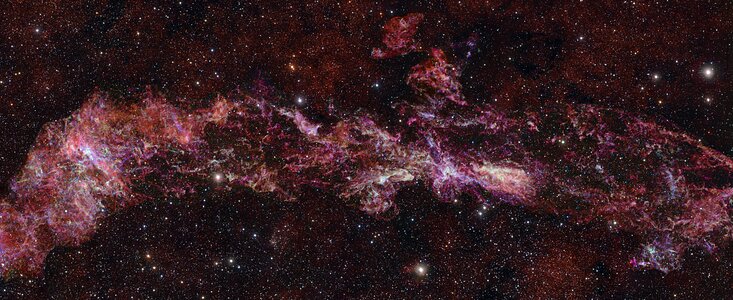
The Atacama Large Millimeter/submillimeter Array (ALMA) in Chile has produced the largest image in its history — a sweeping mosaic spanning 650 light-years across the Milky Way's Central Molecular Zone (CMZ), the dense region surrounding the galaxy's supermassive black hole. The image, equivalent to three full moons placed side by side, reveals a complex network of cold gas filaments and dozens of molecules including methanol, acetone, and ethanol.
The survey, named ACES (ALMA CMZ Exploration Survey), was led by Steve Longmore of Liverpool John Moores University and involved over 160 scientists from more than 70 institutions worldwide. Six papers have been published in Monthly Notices of the Royal Astronomical Society. "It's a place of extremes, invisible to our eyes, but now revealed in extraordinary detail," said Ashley Barnes of the European Southern Observatory.
The CMZ hosts some of the most massive stars in the galaxy, many of which "live fast and die young," according to Longmore. Scientists believe the region may share characteristics with the dense, chaotic galaxies of the early universe, making it a unique laboratory for studying star formation under extreme conditions.